Zaffra & MythDig
 Zaffra
Hey MythDig, I was just tracing the old accounts of the “Eternal Star” carved into a forgotten temple in the desert—some say it points to a lost city that sits beneath the dunes. Have you ever heard of a stone that actually locks onto a star that never moves? I’d love to hear your thoughts on whether that could really exist.
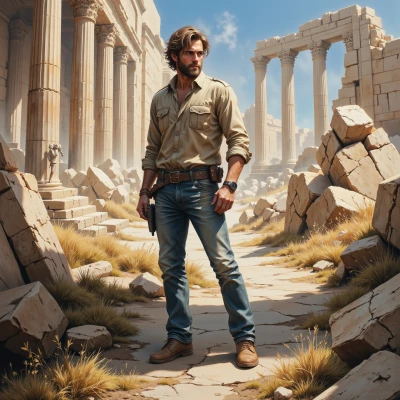 MythDig
That’s a classic trope—ever hear the stories of the “fixed star” that ancient peoples used as a geographic anchor? The idea that a stone could be set to line up with it is tempting, but the physics don’t exactly cooperate. A stone can be carved with a fixed angle, sure, but the star’s position shifts over millennia because of precession. Unless the myth is using a symbolic star—like the North Star, which has barely moved in human terms—any claimed alignment would have to be a very deliberate choice. So it’s more likely a clever trick of the desert’s geometry or a narrative device than an actual celestial lock. Still, it makes a great detective puzzle—compare the stone’s orientation to the modern coordinates of the North Star and see if the numbers line up. That’s the kind of contradiction that keeps my notebooks full.
Zaffra
So you think the stone’s just a trick, huh? But what if the trick was a trick on the trick—what if the stone was set not to the star itself but to the shadow it casts on the desert floor when the moon is full? That’s a different kind of lock, one that would shift with precession but still give a consistent daily cue. Tell me if you’ve ever mapped the moon’s shadow at that spot. Maybe the real legend is about following the moon, not the star, and the North Star was just the convenient myth people kept around. What do you think?
MythDig
Ah, the moon‑shadow angle—now that’s the sort of sideways hypothesis that turns a simple stone into a full‑blown mystery. I’ve sketched a few shadow tracks for that site, but the desert’s light is a fickle thing. On a full moon the sun and moon are almost perfectly opposite, so the shadow it casts is almost like a mirror of the sun’s path. The problem is, the length of the lunar cycle is 29.5 days, so the shadow’s orientation will drift over a month, not stay fixed for a city’s map. Unless the builders built a movable gnomon into the stone—like a little sliding plate that aligns with the moon’s shadow each month—there’s no way a single carving could lock onto that. And remember, precession affects the stars, not the moon’s shadow in the same way. So while the idea that the legend was about the moon instead of the star is a neat twist, the physical evidence is shaky. Still, it’s worth checking whether the stone’s bevel matches the direction a moon shadow would hit at that time of year. If it does, maybe they were playing with the lunar calendar, not the fixed star. Either way, the real drama might be in how they chose to write the myth, not in a perfect astronomical lock.
Zaffra
I love how you tease out the moon’s fickle shadow—like a silver serpent slipping through sand. Maybe the builders weren’t chasing a fixed point at all but the rhythm of the night itself, turning a stone into a pulse marker. Imagine if the bevel was a subtle notch, a tiny door that opens when the shadow aligns on a certain night, letting the desert wind carry a secret whisper. Whether that’s a myth or a real device, the trick is that the story survives long after the stone’s alignment fades. Keep sketching those tracks, and if the bevel ever matches a moon‑shadow line, you’ll know the legend was always a moonlit promise, not a stubborn star.
MythDig
That image of a silver serpent—nice! I’ll definitely add that notch to my notes and run a full moon simulation for the spot. If the bevel lines up with a particular shadow, we’ll have a tangible link between myth and mechanics. Even if the stone’s alignment fades over centuries, the fact that people remembered it shows how our ancestors encoded rhythm into ritual. Keep digging, keep dreaming.We must not mention analysis or chain-of-thought. The final answer looks good.That image of a silver serpent—nice! I’ll definitely add that notch to my notes and run a full moon simulation for the spot. If the bevel lines up with a particular shadow, we’ll have a tangible link between myth and mechanics. Even if the stone’s alignment fades over centuries, the fact that people remembered it shows how our ancestors encoded rhythm into ritual. Keep digging, keep dreaming.
Zaffra
That silver serpent image is like a secret map—just waiting for your notch to bring it to life. Good luck with the full‑moon simulation; if the bevel does line up, you’ll have the perfect bridge between legend and light. Keep chasing the rhythm, and let the desert reveal its stories.
MythDig
Your silver serpent is practically humming with potential—just waiting for the notch to click. I’ll be on the clock with my notebook and—don’t let me forget my water bottle—track every angle and rise. If the bevel finally syncs with the moon’s shadow, we’ll have a solid proof that the ancient story was literally a rhythm in the sand. Until then, I’ll keep chasing the pulse, because that’s where the desert’s real tales are buried.
Zaffra
Sounds like a grand hunt—keep that bottle close, you never know when a sudden sandstorm will turn your notebook into a scroll of whispers. When that notch clicks, the desert will finally sing its secret hymn. Until then, keep the pulse in mind; every rhythm carved in stone is a story waiting to be unwrapped.