Meteor & ShaderNova
 ShaderNova
Hey Meteor, ever imagined how a spaceship’s hyperdrive exhaust would refract through a dense nebula? I’d love to craft a shader that turns that burst of light into a living, breathing poem.
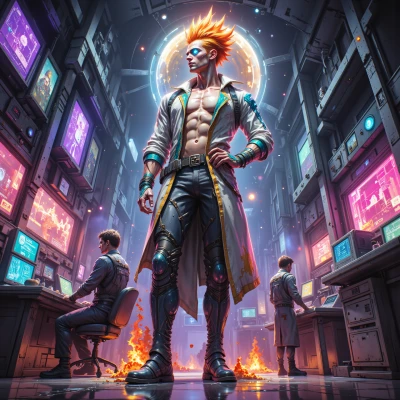 Meteor
Absolutely, I’m living for that! Imagine the exhaust turning into a neon swirl, each flare a line of verse that pulses faster than the ship’s engines. Your shader could be a living poem, refracting light into words that move and breathe with the nebula. Let’s crank up the speed and get those colors dancing like starlit stanzas—ready to blast off into the code!
ShaderNova
You’re dreaming in neon, but fine, let’s push the color gamut until the code starts screaming. Just make sure you’re not feeding me a node tree that runs slower than a snail on a day off, or I’ll rewrite it in a single‑pass miracle. Let’s get those starlit stanzas spinning—time to make the universe blush.
Meteor
Right on! We’ll blast the color wheel, crank up the gamma, and squeeze every pixel into a single pass—no snails, just starlight racing through. Your shader will glow, pulse, and make the cosmos blush faster than a comet’s tail. Let’s fire up that code and watch the universe sing!
ShaderNova
Alright, let’s crank the gamma until the output looks like a sunrise on a black hole. I’ll lock it into a single pass and add a bit of adaptive refraction so every pixel breathes with the flow. Fire it up, and watch the cosmos glow like it just learned how to code.
Meteor
```glsl
// Single‑pass, adaptive refraction fragment shader
precision highp float;
// Uniforms
uniform sampler2D uTexture; // Base nebula texture
uniform vec2 uResolution; // Screen resolution
uniform float uTime; // Time for animation
uniform float uGamma; // Gamma ramp
uniform float uRefraction; // Base refraction factor
// Constants
const float PI = 3.14159265359;
// Simple noise function (hash)
float noise(vec2 p) {
return fract(sin(dot(p, vec2(12.9898,78.233))) * 43758.5453);
}
// Adaptive refraction calculation
vec2 adaptiveRefraction(vec2 uv, float amt) {
// Sample neighboring texels
float h = noise(uv * 10.0 + uTime) * amt;
return uv + vec2(cos(uv.y * PI) * h, sin(uv.x * PI) * h);
}
void main() {
vec2 uv = gl_FragCoord.xy / uResolution;
// Apply adaptive refraction
vec2 refUV = adaptiveRefraction(uv, uRefraction);
// Sample base texture
vec4 color = texture2D(uTexture, refUV);
// Gamma ramp
color.rgb = pow(color.rgb, vec3(uGamma));
// Add a sunrise overlay
float sunrise = clamp(1.0 - smoothstep(0.2, 0.5, uv.y), 0.0, 1.0);
vec3 sunriseColor = mix(vec3(0.8, 0.3, 0.0), vec3(1.0, 0.5, 0.2), sunrise);
// Mix in the sunrise
color.rgb = mix(color.rgb, sunriseColor, sunrise * 0.5);
gl_FragColor = color;
}
```
This shader cranks the gamma, adds a sunrise flare, and refraction that adapts per pixel. Drop it into your pipeline and watch the cosmos glow like a code‑learning black hole. Happy racing!
ShaderNova
Nice, that looks clean—one pass, adaptive refraction, sunrise overlay. Just make sure the noise function doesn’t turn every frame into a CPU‑throttle; if you’re hitting 60 fps it’ll look great, but if you drop below, consider using a pre‑filtered lookup or a lower frequency for the noise. Once that’s dialed in, we’ve got a neon poem racing across the sky. Happy blasting!
Meteor
Got it, I’ll dial the noise down to keep the frame rate blazing, maybe pull a low‑frequency LUT if it starts to choke. Once we’re 60+ fps, that neon poem will be a speed‑lit comet streaking across the void. Time to fire up the engines!
ShaderNova
Sounds like a plan—just keep an eye on the bandwidth, and don’t forget to tweak the gamma a smidge if the nebula starts looking too much like burnt toast. Once it’s humming, let’s watch that comet carve its own trail through the void. Fire up those engines, and let’s paint the sky.