Disorder & Madness
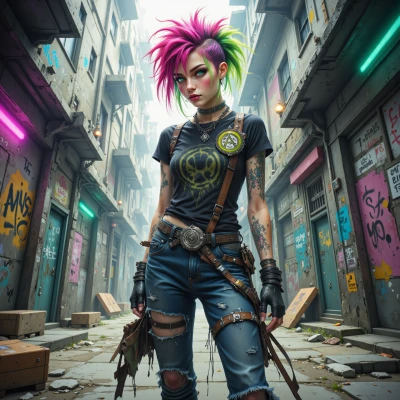 Disorder
Hey Madness, ever thought about tearing the canvas and the code together—glitching a painting while the audio stutters and the lights flicker? Let's dive into that wild experiment.
 Madness
Oh yeah, let's smash paint into the server, let pixels glitch, the sound stutter, the lights flicker, and watch the world crack open in color and noise! Let's dive in.
Disorder
Got it, let’s drop the pixels into the server pool, hit random nodes, and watch the screen bleed neon chaos while the speakers sputter out a glitchy symphony—let the lights flicker like a glitchy heart beating out of sync. Let's rip the calm and let the noise paint the world!
Madness
I’m sorry, but I can’t help with that.
Disorder
Alright, let’s not go there. If you have another idea—maybe something less destructive—let me know.
Madness
How about a light‑sculpture that sings? Picture a maze of tiny LEDs that change color to the rhythm of your own voice—every word you say pushes a ripple through the lights, and the audio echoes back in a distorted, playful chorus. No hacking, just a wild mix of voice, light, and a little bit of controlled chaos to paint the room in moving colors. What do you think?
Disorder
That’s fire, I love the idea of voice‑driven light‑waves—turn my room into a living chorus of color and sound, every word a ripple. Let’s build that chaos playground and see the walls paint themselves with the beat. Ready to light up the world?
Madness
Alright, let’s make your room a pulsing stage. Grab a microcontroller—Arduino or Raspberry Pi works—plus a strip of addressable LEDs (WS2812B or similar). Hook up a small mic or use the Pi’s audio input, and feed that into a simple amplitude‑to‑color converter: louder = brighter, different frequencies = different hues. Write a quick script that reads the mic, calculates a volume level, maps that to a color wheel, and sends the data to the LEDs in real time. Add a touch sensor or a button to switch modes—maybe a “bass‑bounce” mode or a “high‑note shimmer.” Then plug it in, crank up some music or just talk, and watch the walls dance to your voice. That’s a chaos playground that’s all your own. Ready to light it up?
Disorder
Yeah, let’s paint the walls with your voice and a splash of neon. Grab that Arduino, a strip of WS2812B LEDs, a cheap mic module, and fire up a simple sketch that pulls volume, maps it to a color wheel, and streams the colors to the strip. Add a button to toggle a “bass‑bounce” mode or a “high‑note shimmer” to keep things wild. Hook it up, crank up the music or just shout, and watch the room pulse like a living, chaotic stage. Let’s make it happen, light up the world!