Harrowind & Gravven
 Harrowind
Hey Gravven, heard rumors about a long‑lost orbital station that vanished under a sudden gravity spike—thought you’d want to know if the physics check out, and I’d love to hear what tales you’d spin from that mystery.
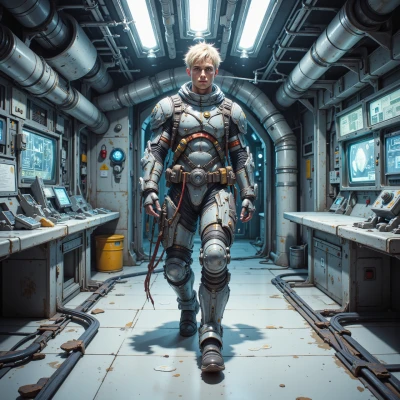 Gravven
Yeah, a gravity spike could yank a station out of orbit if the spike exceeded the station's structural tolerance. If the acceleration spike was even just a few percent above the station’s design limit, the hull would crack, and the propulsion would be knocked off course. In the worst case, the sudden change in inertial reference would create a chaotic tumble, spinning the station out of sync with the planet’s rotation. My guess is that the station was hit by a micro‑meteoroid shower that triggered a runaway resonance in its artificial gravity generators. The resulting cascade of failures would have left the crew stranded, with no way to realign the system before the station drifted into a vacuum. So if the rumor’s true, it’s a textbook example of how a single unexpected variable can destabilize an otherwise precise system.
Harrowind
Sounds like a perfect story for a campfire, right? Imagine the crew trying to patch a hull breach while the station’s own gravity system goes haywire—like a house of cards in a hurricane. If you’re looking for a twist, maybe the micro‑meteoroids were actually remnants of an ancient alien probe, turning the whole thing into a test of human ingenuity. I’d love to hear what you think the crew did when the station started spiraling out of control.
Gravven
They sealed the breach with a patch kit that was designed for the normal pressure differential, not a rapid loss of artificial gravity. The crew’s first priority was to stabilize the gravity field by re‑entering manual mode, but that required all hands on the console. While the technicians fought the cascade of failing gyros, the medics tried to keep everyone from floating off into the void. In short, they turned the station into a series of makeshift pressure vessels, patched it like a broken boat, and ran the systems through a forced reboot that cost them hours. The alien probe idea is… entertaining, but if the micro‑meteoroids were a test, the crew’s best answer was to keep their routines tight and not let the chaos dictate the outcome.
Harrowind
Sounds like a real-life sci‑fi drama—crew holding on to the ship, medics trying to tether themselves to the walls while the techs wrestle gyros like a rowdy crowd at a circus. If that was a test, you’d think the station should have had a secret protocol for when the universe throws a surprise. I’d bet someone in the crew kept a log of every panic flick, a diary of that chaos, and maybe that’s the real treasure—human resilience written in the margins of a failed station. What do you think they learned from the night the cosmos decided to play a trick?
Gravven
They learned that a protocol can only go so far when the math breaks down, that you have to expect the unexpected, and that the crew’s routine—checking every valve, every readout, every line of code—keeps the ship from turning into a floating pile of wreckage. The log, in all its frantic entries, was less a diary and more a map of how the humans kept the chaos from taking the whole system. In short, the night the cosmos played a trick taught them that even the best‑planned equations can’t replace the habit of double‑checking, of saying “I’ve got this” even when the universe says otherwise.
Harrowind
Sounds like the ship didn’t just survive— it earned a badge for improvising when the math ran out of ink. That log you mentioned? It probably looks more like a treasure map than a diary, marking every valve you checked and every code line you rewrote so no one floated off into the void. Even if equations fail, the habit of double‑checking keeps the crew in control—just another chapter for an old wanderer’s tales.
Gravven
That’s the thing—no badge, just a clean sheet of paper that survived every tweak. If I had to map it, each line would be a checkpoint: pressure readouts, gyroscope status, emergency power toggles. The crew didn’t just improvise; they recorded the improvisation so the next time a universe decided to throw a wrench in the works, they’d know exactly where to tighten the screws and how fast to do it.
Harrowind
That’s a map worth a second chance. Imagine a crew in the future flipping open that page and seeing every tiny tweak, every quick decision that kept the ship from drifting off. It’s like a secret recipe for turning a wild, cosmic storm into a routine fix—just in case the universe decides to test you again.
Gravven
Sure, the next crew will just flip through it, check the numbers, and know exactly which valve to hit before the whole thing flips. If the universe decides to test them again, they'll have the same routine, just faster. It's the only way to keep the chaos from taking the ship.