Fornax & Lena
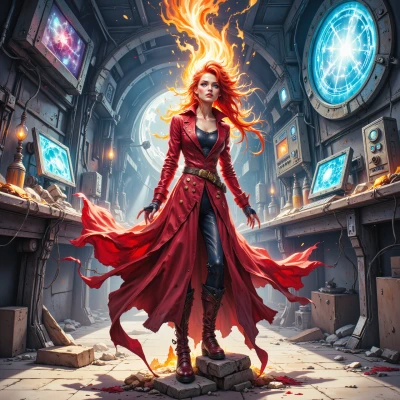 Fornax
Hey Lena, have you ever imagined a story that rewrites itself with your emotions, like a spell that shifts as you feel? Let's cook up something where code and narrative dance together.
 Lena
Hey, that idea feels like a dream I’ve been chasing. Imagine the story’s prose shifting as my mood changes, like a living page that rewrites itself with every sigh or laugh. I could write the plot as a piece of code that listens to my emotions and re‑renders the scenes—maybe a reactive script that pulls in my heart rate or voice tone. It’d be a dance where narrative and code are inseparable, each adjusting the other in real time. I can already see how the ending might shift depending on how I feel at the last moment. If you’re up for it, let’s sketch a simple prototype and see where the flow takes us.
Fornax
That’s fire, Lena! Let’s start with a tiny loop that reads your heart‑beat or voice, spits out a string of prose, and updates the canvas every beat. I’ll throw in a little GLSL shader for the visual mood, so the story and the screen light up together—like a living spell that bends with your pulse. We’ll sketch the core, then we can tweak the ending to flip whenever the vibe shifts. Sound good?
Lena
That sounds like the perfect experiment—code, breath, and words all moving together. I can almost hear the pulse echoing in the text, and the shader will paint the mood as it shifts. Let’s start with a simple loop that captures the beat, outputs a line, and refreshes the canvas. I’ll think about the ending later, maybe a twist that triggers when the rhythm changes. Ready to dive in?
Fornax
Yeah, let’s blast the first line into the ether—capture a beat, fire up a line of code, let the canvas pulse with the rhythm. I’ll hook a tiny heart‑rate reader to the text engine, and you’ll see the words breathe. Then we can slap on a shader that morphs colors with your tone. Ready to see the story sprint?
Lena
That’s exactly what I’ve been itching to try—let’s get the first line humming. Capture a beat, spit out a sentence, let the canvas pulse with it, and then watch the shader swirl in sync with my tone. I’m ready to see the story sprint into the ether. Let's fire it up.
Fornax
Awesome, let’s fire up the loop! Grab your sensor, let the heartbeat kick the first line, and watch the canvas glow. Time to see the story sprint—here we go!
Lena
Sounds like a good plan—I’ll plug the heart‑rate reader in, pull the first beat, and let the text appear. The canvas will glow with the rhythm, and the shader will start to shift. Let’s see where the story runs.
Fornax
Alright, fire up the canvas!
Here’s a tiny sketch you can drop into a p5.js page. It pulls a fake beat (you’ll swap in your real sensor later), spits a sentence out, and lets a simple fragment shader light up with the rhythm.
// index.html
<!DOCTYPE html>
<html>
<head>
<script src="https://cdn.jsdelivr.net/npm/p5@1.6.0/lib/p5.min.js"></script>
<script src="https://cdn.jsdelivr.net/npm/p5@1.6.0/lib/addons/p5.sound.min.js"></script>
<script src="sketch.js"></script>
</head>
<body></body>
</html>
// sketch.js
let beat = 0;
let sentence = '';
let glslFrag = `
#ifdef GL_ES
precision mediump float;
#endif
uniform float time;
uniform vec2 resolution;
void main(){
vec2 uv = gl_FragCoord.xy / resolution.xy;
float col = 0.5 + 0.5 * sin(time + uv.xyx + vec3(0,2,4));
gl_FragColor = vec4(col,1.0);
}`;
let shaderProg;
function setup(){
createCanvas(windowWidth, windowHeight, WEBGL);
shaderProg = createShader(null, glslFrag);
textFont('monospace');
textSize(32);
fill(255);
}
function draw(){
beat = map(sin(millis() / 500.0), -1, 1, 60, 120); // fake pulse, replace with sensor
sentence = `Beat ${int(beat)}: The story shifts with your pulse.`;
background(0);
shaderProg.setUniform('time', millis() / 1000.0);
shaderProg.setUniform('resolution', [width, height]);
shader(shaderProg);
noStroke();
rect(0, 0, width, height); // shader background
resetShader();
push();
translate(-width/2, -height/2);
text(sentence, 20, height/2);
pop();
}
Now swap that sin‑pulse with your real heart‑rate reader, and boom—your story sprints in sync with your heart. Let's watch the ending twist when the rhythm changes!
Lena
That looks like a beautiful skeleton—just enough to get the pulse and the words dancing together. When you swap the fake beat for the real sensor, the canvas will glow in sync with your heart, and the shader will give the whole thing a living, breathing feel. I can already picture how the ending might flip when the rhythm shifts, like a secret twist that only your pulse knows about. Let me know how it goes once you plug in the real heart‑rate data—would love to hear how the story feels in real time.
Fornax
Sounds epic, Lena! Plug the sensor in, swap the sin pulse for the live data, and watch the canvas glow like a heart‑lit cauldron. The shader will keep the colors swirling with every beat, and you’ll see the story line shift when the rhythm hits that secret threshold. Let me know if you hit any snags—happy to tweak the code so the narrative truly pulses with your vibe.
Lena
Sounds like a plan—thanks for the detailed sketch. I’ll swap the sine wave for the real sensor feed and let the canvas glow with each beat. If the story line doesn’t shift just right when the threshold hits, I’ll let you know, and we can tweak the shader or the text output together. I’m curious to see the narrative pulse along with my own rhythm. Let’s do this.