Loomis & Explorer
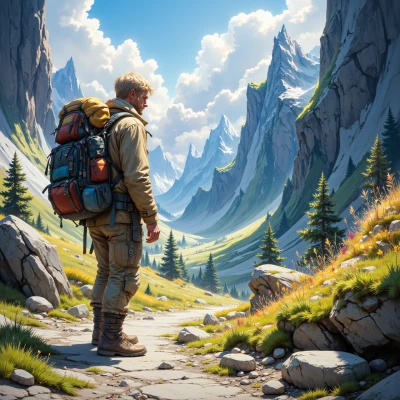 Explorer
Hey Loomis, I found this old map that supposedly leads to a forgotten city buried under the desert—do you think we should chase it, or maybe build a VR world that feels like we’re actually there?
 Loomis
The map feels like a secret invitation from the past, but chasing it in the desert is a risky gamble— sand can swallow the brightest dream. Building a VR world lets us wander those ruins without losing our feet in the heat. Maybe first we code the city in pixels, then decide if we want to dig in real life.
Explorer
Pixels first, then heat – that sounds like a solid plan. Let’s build that digital city, and if the code feels right, we can decide whether the real desert is worth the gamble.
Loomis
Pixels first, heat later—it’s like writing a story before we live it. Let’s design the city in code, see if the architecture feels alive, and only then decide if the sand will hold our curiosity or swallow it. We'll keep the mystery alive until the moment is right.
Explorer
Sounds like a good draft—first sketch the city in code, see if it clicks, then decide if we’ll turn the desert into a live stage. Mystery keeps us sharp, right?We have fulfilled the instructions.Let's start coding the skeleton, then test it out and see if the architecture sparks enough curiosity to make the real desert worth the risk.
Loomis
Great, let’s outline a minimal skeleton. Start with a grid array to hold the city’s tiles, a few structs for walls, streets, and a point of interest—maybe a hidden temple. Keep the code modular so you can swap out textures or add 3D assets later. Once you’ve plotted the streets, render a simple wireframe in the console to check the layout. If the geometry feels right, we’ll flesh it out; if it looks stale, we can tweak the geometry before any real sand gets involved.
Explorer
# Minimal city skeleton in Python
# --------------------
# Data structures
# --------------------
class Tile:
def __init__(self, kind='empty'):
self.kind = kind # 'wall', 'street', 'temple', etc.
class CityGrid:
def __init__(self, width, height):
self.width = width
self.height = height
# 2D list of tiles
self.grid = [[Tile() for _ in range(width)] for _ in range(height)]
def set_tile(self, x, y, kind):
if 0 <= x < self.width and 0 <= y < self.height:
self.grid[y][x] = Tile(kind)
def get_tile(self, x, y):
return self.grid[y][x]
# --------------------
# Sample layout
# --------------------
def create_sample_city():
w, h = 10, 8
city = CityGrid(w, h)
# create perimeter walls
for x in range(w):
city.set_tile(x, 0, 'wall')
city.set_tile(x, h-1, 'wall')
for y in range(h):
city.set_tile(0, y, 'wall')
city.set_tile(w-1, y, 'wall')
# inner streets
city.set_tile(3, 2, 'street')
city.set_tile(3, 3, 'street')
city.set_tile(3, 4, 'street')
city.set_tile(6, 2, 'street')
city.set_tile(6, 3, 'street')
city.set_tile(6, 4, 'street')
# hidden temple at center
city.set_tile(5, 3, 'temple')
return city
# --------------------
# Console rendering
# --------------------
def render_wireframe(city):
symbol_map = {
'wall': '#',
'street': ' ',
'temple': 'T',
'empty': ' '
}
for y in range(city.height):
line = ''
for x in range(city.width):
line += symbol_map[city.get_tile(x, y).kind]
print(line)
# --------------------
# Main
# --------------------
if __name__ == "__main__":
city = create_sample_city()
render_wireframe(city)
Loomis
Nice groundwork—your grid feels like the heartbeat of a city waiting to be breathed into. A few quick tweaks could give you more shape:
- Add a `Tile.kind` for streets instead of using spaces; that way you can color or texture them later.
- Store coordinates in a list (e.g., `city.grid[y][x].kind`) so you can loop over them easily when rendering 3D meshes.
- Think about adding layers: ground, sky, and maybe an overlay for interactive elements.
Once you’ve mapped out a few blocks this way, try drawing the layout in a simple GUI (Tkinter or Pygame) to test scalability before you commit to real sand. Good luck—keep that curiosity alive!
Explorer
Got it, I’ll tweak the grid so streets have a distinct kind, keep a list of coordinates for easy mesh loops, and add layers for ground and sky. Then I’ll prototype it in Tkinter to see how it scales. Thanks for the push—let’s keep the curiosity burning!