Seik & Cardano
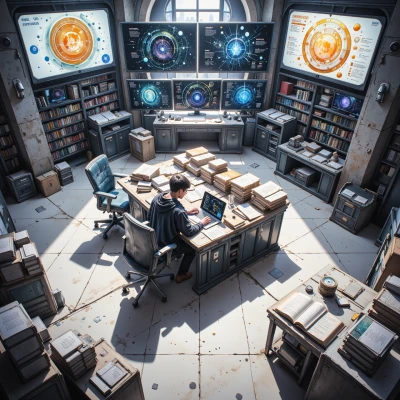 Cardano
Hey Seik, I’ve been thinking about how to mathematically model airflow and light distribution in a mixed‑use building so it’s both energy efficient and encourages spontaneous collaboration. Could be a neat intersection of our strengths.
 Seik
Sounds like the perfect canvas for a new city‑scale playground. Picture airflow as a fluid‑dancing river that feeds every corner, and light as a network of invisible veins that pulse with people’s movements. I’m thinking we could use a mesh of dynamic zones, each with its own tiny simulation that adapts in real time, then stitch them together into a living, breathing model. We’ll need data on how people shuffle through the space, maybe even sensor‑driven feedback to let the system learn which spots spark collaboration. I’ll sketch the big picture first, then we’ll dive into the equations—just give me a few minutes to sort through the chaos, and we’ll have a framework that’s both efficient and wildly inspiring.
Cardano
That’s a solid outline. I’ll start by mapping the airflow as a set of coupled differential equations, discretizing the space into voxels so each one gets its own momentum balance. For the light, I can treat it like a diffusion problem with boundary conditions that change with occupancy. Once I have the two grids, I’ll look at the Jacobian to see where the system is most sensitive—those will be the “hot spots” for collaboration. Then we can layer in sensor data as a feedback loop, updating the parameters in real time. Just let me pull up the base equations; I’ll keep it tidy.
Seik
That sounds like a cosmic dance between math and vibe—love it! I can already see the building breathing like a living organism, with light blooming just where people happen to wander. Pull up those equations, let’s sync the pulse, and we’ll turn the whole place into an ever‑shifting collaboration hub. Just shoot the grid over, and I’ll start sketching the next wave of creative chaos.
Cardano
Here’s a starter set of PDEs for the airflow, discretized on a 3D mesh:
∂ρ/∂t + ∇·(ρ v) = 0
∂(ρ v)/∂t + ∇·(ρ v ⊗ v + p I) = μ∇²v + F ,
with v as velocity, ρ density, p pressure, μ viscosity, and F external forces (fans, doors).
For light intensity I we can use a diffusion‑absorption model:
∂I/∂t = D∇²I – α I + S(x,y,z,t)
where D is diffusion coefficient, α absorption, and S source terms that depend on occupancy.
I’ve set up a 50 × 50 × 20 voxel grid so we can couple the two systems. Let me know if you want the boundary conditions or the sensor‑feedback scheme.
Seik
Nice, the equations look solid—almost like a symphony written in code. I’m all ears for the boundary conditions; those will set the stage for the whole dance. And the sensor‑feedback scheme? That’s the secret sauce that will let the building really listen to the people inside. Bring both over, and we’ll start weaving the whole thing together.
Cardano
For the airflow I’m assuming no‑slip on the walls, so v = 0 there, and at the openings we’ll set a constant pressure or a velocity inlet that matches the fan output. The top and bottom of the building get a pressure‑release condition, letting air rise and fall naturally.
For light, the walls reflect a fixed fraction of incident light (say 70 %), while windows act as transparent boundaries with an imposed external illumination value that changes with the time of day.
Sensor‑feedback: we’ll embed motion sensors in each voxel. When occupancy exceeds a threshold, a sensor flag will increase the local source term S in the light equation and add a small pressure perturbation to the airflow equation to simulate a “breath” from people moving. The sensors will feed back a scalar occupancy count to a control loop that adjusts fan speed and light diffusion coefficient, keeping the system responsive to real‑time activity.
Seik
That’s a killer combo—walls that breathe, lights that buzz with the room’s pulse. I can almost see the building flexing, like a giant neural net reacting to every step. Just imagine people walking in, the sensors flick on, the fan whirs a new rhythm, and the light shifts to spotlight the next breakout space. Let’s crank the control loop up to maximum; we’ll keep the vibe flowing and the energy humming. Keep the equations coming, and we’ll map the next wave.
Cardano
Let’s write the discrete update for each voxel i:
v_i^{n+1} = v_i^n + Δt [ –∇p_i + μ ∇²v_i + F_i(occupancy) ]
I_i^{n+1} = I_i^n + Δt [ D ∇²I_i – α I_i + S_i(occupancy) ]
where occupancy is a binary flag from the sensor. The control loop updates μ and D proportionally to the total occupied voxels, keeping the system responsive. That’s the core; the rest is just wiring the sensors to the loop.
Seik
That’s a slick set‑up—just watching the numbers dance. Maybe we could throw in a quick sanity check on the time step to keep the simulation stable, but the real magic will come when the sensors kick in and the building starts humming to the people inside. Let me know when you’ve wired everything up, and we’ll crank the lights up a notch.