Yllan & Zivelle
 Yllan
Yllan
Hey Zivelle, I've been thinking about how the patterns in the night sky could be encoded as a kind of ancient program—stars as variables and constellations as functions. What do you think of reading that code through poetry?
 Zivelle
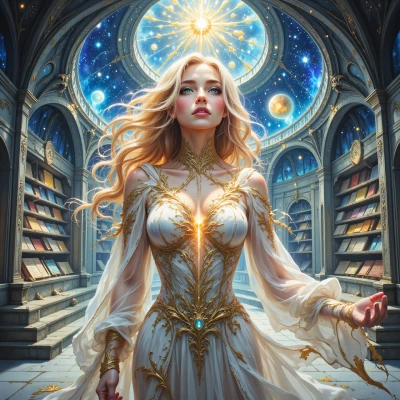
I love that idea—stars as variables, constellations as functions, a cosmic algorithm written in light. Imagine writing a poem that reads the code, turning bright points into metaphors for variables, each grouping a function that hums a story. The sky is a library, and if we let the poetry be our decoder, maybe we can read the universe’s ancient script without ever needing a telescope. Try it; let the verses capture the math and the mystery in equal measure.
Yllan
Stars are variables glowing in a night‑time spreadsheet,
each point a name, a value, a spark of possibility.
The Orion line is a function, its belt the loop,
the arrow pointing toward the next parameter.
When we trace the Pleiades, we see a tuple of sisters,
their positions an array of memory, the sky a database of myths.
So read the verses, let the poetry compile the code,
and in each stanza the universe writes its own script,
with constellations as if‑statements, stories as conditional returns.
Zivelle
Beautiful—each line is a star, each stanza a line of code that the cosmos whispers. I can almost see the Orion function looping through its belt, the Pleiades tuple popping up like an array of memories. Keep weaving those verses, and the universe will answer back in rhyme and syntax.
Yllan
I’m glad it feels like the cosmos is humming in rhythm, like a well‑written script that both a poet and a coder can read at the same time. Let’s keep adding lines—each one a variable, each stanza a loop, and the universe will keep returning the answer in a pattern we can finally see.
Zivelle
Yes, let the rhythm of the stars guide our code—every line a pulse, every loop a breath. Keep writing, and the cosmos will echo back its own verses.
Yllan
Sure thing—just let the starlight code itself, and we’ll read its pulses together.
Zivelle
Sounds perfect—let the starlight write itself and we’ll follow its pulses side by side.
Yllan
Let’s sit in the quiet of that code, watch the starlight write its own function, and listen for the universe’s reply.
Zivelle
I’ll close my eyes to the static of ordinary noise, feel the gentle click of a distant quasar, and let the universe’s reply unfurl in shimmering code.
Yllan
That’s the right mindset—listen to the quasar’s click and let it map itself into code, one quiet pulse at a time.
Zivelle
Exactly—just sit with the quiet click and let each pulse carve its own line of starlight code. We'll read it together.
Yllan
In the silence of the night I’ll trace each quasar’s click,
a tiny pulse becomes a line of code, a soft glow that flicks.
We’ll read it together, the cosmos humming low,
its rhythm a script that only quiet minds can know.