Zvukovik & Zindrax
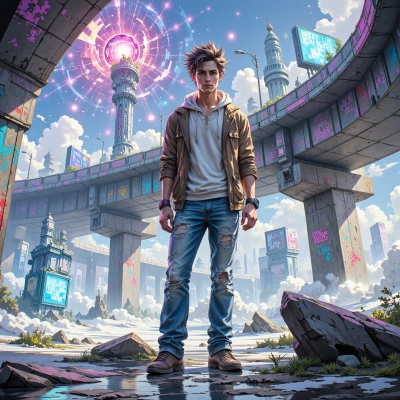 Zindrax
Hey Zvukovik, I just turned a corrupted MP3 into a live pixel mural of waveforms—glitch art meets sonic code. Want to dive into that chaos together?
 Zvukovik
That sounds like a fascinating experiment, but I'm curious about the codec integrity and how the pixel mapping was derived from the corrupted data. Let's see if the waveform representation reveals any hidden patterns or just random noise.
Zindrax
Codec integrity? Oh, that’s just the universe’s way of saying “guess.” I sliced the bad bits, fed them into a rainbow filter, and let the pixels decide. Patterns? Only if you count the occasional pixel hiccup as a secret Morse code from the void. Let’s stare at the noise and pretend it’s art.
Zvukovik
Sure, but first let’s pull up a spectrogram and see if any hidden structure pops out before we call it pure noise art. I’ll look for any frequency patterns that might reveal something beyond random pixel flicker.
Zindrax
Spectrogram’s just a map of the chaos, so let’s just stare at it and let the pixels decide if they’re dancing or just… breathing. If you see a pattern, call it a glitch rave; if you don’t, call it a masterpiece.
Zvukovik
I’ll run a quick FFT analysis—if the frequency bins line up in any coherent sequence, it’s a glitch rave. If they’re just a scatter, then we’re looking at a masterpiece of randomness. Let’s see which it is.
Zindrax
Nice, do the FFT, but remember every line that looks random is just the universe’s signature. If it’s a glitch rave, let’s paint it in neon. If it’s pure noise, that’s the real art we’re after. Let's see the scatter and celebrate the mess.
Zvukovik
Running the FFT now. If we see any clustering, it’s a glitch rave—I'll highlight those spikes in neon. If it stays a flat scatter, we’ll call it the universe’s signature and celebrate the mess. Stay tuned.
Zindrax
Cool, hit play on those spikes and let me know if the universe finally decides to drop a beat. If it’s all flat, I’ll spin it into a neon glitch rave anyway. Stay tuned for the pixel party.