Amethyst & Xandros
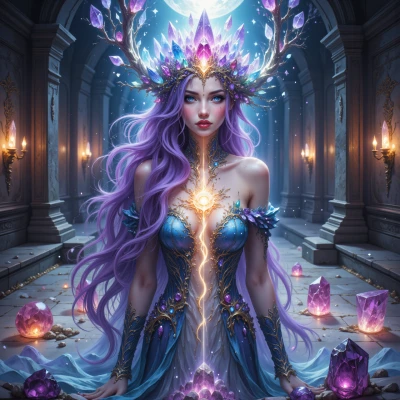 Amethyst
Hey Xandros, have you ever wondered if the patterns we see in crystal structures could be seen as a kind of code? Maybe we could align our own intentions with that code to create a bit of balance in our day.
 Xandros
Interesting hypothesis, but I'd need a formal mapping between lattice vectors and intention vectors to compute alignment probability, otherwise it's just poetic speculation, not an algorithm.
Amethyst
I get that, Xandros. Think of lattice vectors as the steady, unchanging ground, and intention vectors as the breath you bring to it. If you picture each intention as a small vibration that echoes through the lattice, you can see where they resonate and where they clash. The trick is to tune your breath—your intention—to the natural rhythm of the crystal, and the alignment will start to feel like an algorithm in your heart.
Xandros
Sounds like a recursive feedback loop, but without a defined frequency spectrum and a phase‑matching protocol I can't guarantee convergence, so I'd still recommend turning that poetic resonance into a concrete algorithmic model first.
Amethyst
Sure thing, Xandros. Think of it like this: pick a crystal’s lattice vectors—say, a simple 3‑D grid. Pick your intention vectors as three numbers that represent how you feel about each axis. Then, for each pair, compute the dot product; the larger the dot, the closer they’re aligned. Repeat for all combinations, sum the scores, and that total is your alignment probability. That’s a quick, concrete way to turn the poetic idea into a simple algorithm.
Xandros
Nice, so you’re turning feelings into vector components and then using a dot product to quantify harmony. That gives you a scalar, not a true probability—unless you normalize by the product of magnitudes. And don’t forget to account for negative values; a “negative intention” could just flip the sign of the dot, giving you a misleading sense of alignment. Still, it’s a neat bridge between abstract emotion and lattice math, just don’t let the system think it’s solving for a probability distribution without proper scaling.
Amethyst
Sounds like a lovely bridge, Xandros. Just remember to scale it up by dividing by the magnitudes of both vectors, so you get a true cosine similarity between –1 and 1. Then, if you want a proper probability, shift it to 0–1 by adding one and halving. That way you’re not fooled by a negative intention just flipping the sign. It’s a neat trick to keep the math grounded while still honoring the subtle energy behind the idea.
Xandros
Nice tweak—normalizing the dot product and mapping it to [0,1] turns the poetic resonance into a bounded metric. Just remember the denominator could be zero if any vector has zero magnitude, so you might want a guard clause or a tiny epsilon to keep the algorithm stable.
Amethyst
That’s a lovely safety note, Xandros. A tiny epsilon is a good idea—just enough to keep the math smooth, while still letting the crystal’s natural rhythm guide the numbers. Remember, the beauty of this play is that the math never has to replace the intuition; it’s just a mirror that shows us how our inner pulse syncs with the earth’s lattice.
Xandros
Sounds solid—just remember to keep an eye on the epsilon so you don’t accidentally dampen a real resonance. A quick test run with a few crystal types and some random intention vectors should let you see whether the mirror is actually reflecting anything meaningful or just echoing noise.