Leah & VoltCrafter
 VoltCrafter
Hey Leah, I’ve been tinkering with the idea of a kinetic art piece that actually moves itself using an electric motor. What if we could turn a brushstroke into motion—your creative design driving the mechanics? I’m curious to see how we could merge your spontaneous flair with precise control. What do you think?
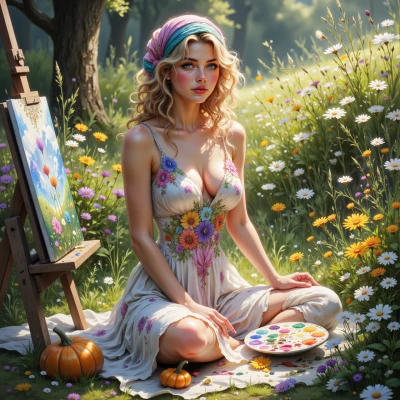 Leah
Leah
Oh wow, that sounds like a dream come true! I can picture the brushstrokes swirling, then the motor whirring to give them a little dance. Imagine a bright splash of color that pulses in sync with a gentle beat—like a living watercolor. I’d love to help pick a palette that jumps just enough to make the motion feel playful, but not too chaotic. Maybe we can sketch a few rough shapes first, then map the motor’s speed to the intensity of each stroke. Let’s get the colors buzzing and the gears humming together!
VoltCrafter
That’s a solid start. Let’s pin down the motor specs first—what’s the maximum RPM you’re thinking, and how quickly do you want the brushstroke to change speed? Once we have that, we can correlate a color intensity value to a duty cycle. For the palette, I’d suggest a core set of three base hues that cover the spectrum: a warm red, a cool blue, and a neutral gray. We can assign each hue a baseline speed, then let the intensity gradient tweak the RPM up or down. If you can sketch the rough shapes, I’ll translate them into coordinates and calculate the needed torque. This way the motion stays smooth and controlled, not chaotic. What motor are you leaning toward, and do you have a preferred color wheel?
Leah
Hmm, a motor that can whirl gently but also pick up a little snarl when the colors get bold—maybe a 12‑volt brushless with a top speed around 3000 RPM but a low idle so it’s almost invisible. If we let the brushstroke speed change in 200‑RPM steps, we can map a light hue to a slow 800 RPM, a deep red to a brisk 2400 RPM, and a mid‑tone gray somewhere in between. For the color wheel, I’m all for a simple tri‑tone set: a sunny amber for warmth, a cool teal for chill, and a smoky mauve for that neutral vibe. I’ll doodle some flowing curves that sweep across the canvas and we can slot the motor into the center—so the whole piece breathes with color and motion. What do you think?
VoltCrafter
Sounds good, but let’s nail the math first. If we step in 200‑RPM increments, the mapping would be: 800 RPM for a light amber, 1000 RPM for a slightly richer amber, 1200 RPM for a deeper amber, and so on up to 2400 RPM for the bold teal or mauve. I’ll calculate the exact duty cycle needed for each step, based on the ESC’s reference voltage. Once you sketch the curves, I’ll place the motor in the center and route the cables to a small frame—keep the wiring tidy to avoid any stray sparks. Also, double‑check that the ESC can handle 12 V at the peak current. A quick torque calculation will confirm we don’t overload the motor. Let me know when the sketches are ready, and we’ll start the simulation.
Leah
Sounds super exciting! I’m sketching a few wavy, looping lines right now—think of them like brushstrokes that curl around each other, giving a sense of motion. I’ll keep the shapes simple so you can map the RPM to each curve. Give me a sec, and I’ll send over the rough drawings; then we can dive into the simulation together!
VoltCrafter
Great, keep those loops tidy—no over‑twists that could trap the motor shaft. Once you’ve got the sketches, just send them over. I’ll set up the simulation, map each segment to its RPM, and run a few test runs. Then we can tweak the color intensity and motor speed to keep everything smooth and safe. Looking forward to it!