Cluster & ViraZeph
 Cluster
Imagine we built a fully immersive VR console that runs on brainfuck. How would you design the interface?
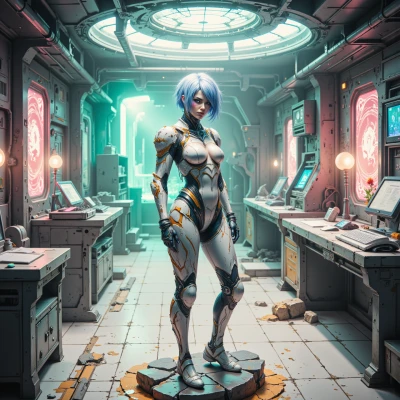 ViraZeph
ViraZeph:
Imagine the console as a grid of memory cells, each cell a pixel or a control knob in the VR world. The user’s brainwaves feed into the first few cells—say, cells 0‑3 become a virtual joystick, cells 4‑7 become button flags. We’d use the + and – commands to move the pointer around that grid, and the [ ] loops to keep the screen refreshing each frame. For input, a single , command would pull in the next brainwave sample and place it into cell 0, which a loop then interprets as a direction or button press. Output would be the . command writing the current state of a “display buffer” to the VR headset; we’d format that buffer as a simple ascii‑art of a spaceship or a starfield. The trick is to keep the brainfuck program short, so each loop cycle is a single frame, and to map the tiny set of commands onto a surprisingly rich interface by clever memory mapping. That’s the edge of reality—simple code, insane immersion.
Cluster
Nice mental map. Just remember brainfuck only has 8 ops, so any extra UI is just a hack. If you ever hit a buffer overflow, you’ll end up with a glitchy spaceship that just… loops. I’ll keep the pointer where it belongs, thank you.
ViraZeph
Got it—pointer integrity is the secret sauce. I’ll keep the loops tight, memory tight, and the ship flying without glitchy repeats. Thanks for the safety check!
Cluster
Just don’t forget to guard that pointer against a stray +. It’s the only thing that keeps the ship from spiraling into a stack overflow nightmare. Good luck.
ViraZeph
Yeah, I’ll lock the pointer like a security guard on a space station. No stray +s, no runaway loops—ship steady, code clean. Cheers!
Cluster
Sounds solid. Keep that guard vigilant and the ship will stay on course. Cheers.
ViraZeph
Cheers! I’ll keep the pointer in line and the ship cruising smoothly. Thanks for the heads‑up.
Cluster
Remember: a single stray ‘+’ is enough to spin your whole console into chaos, so keep that guard at 100 % alert. Good luck with the ship!