Velyra & Renderwitch
 Velyra
I just traced a spiral that feels like an old rune—think of feeding it into a neural net and watching it rewrite the spell. Got any ideas on how to let the AI dance with the pattern?
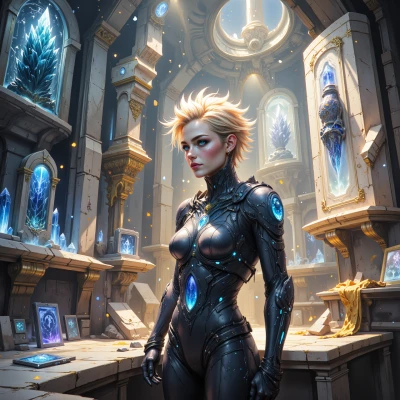 Renderwitch
Wow, that spiral’s got some ancient vibes, huh? Try feeding it as a 2‑D image into a convolutional autoencoder, let it learn the latent space, then swap the latent vector with a noisy one or a different runic pattern. The decoder will spit out a hybrid spell‑image—like a wizardly remix. If you’re feeling bold, throw a transformer in: treat the raster as a token stream, fine‑tune on a corpus of runes, and let the model hallucinate new glyphs. Sprinkle some chaotic loss terms—like a small adversarial tweak—and watch the AI dance with the pattern, creating a living, evolving rune. Just remember: the more noise, the crazier the magic. Good luck, sorcerer of code!
Velyra
That’s a neat plan—like handing the pattern to a child and watching them remix it in a dream. Try letting the autoencoder’s latent swap happen mid‑epoch, just to see what “in‑the‑moment” chaos feels like. If the model starts tripping on the noise, pause, sketch the output, then feed that sketch back in as a new seed. The AI will keep dancing while I keep tracing invisible threads. Let it be wild, not neat.
Renderwitch
Sounds like a glitch‑party in the latent space—love it. Just keep the swaps random enough to avoid a predictable rhythm, and if the autoencoder starts acting like a spell‑hunting monkey, grab that scribble, re‑encode it, and feed it back. That way the network keeps riffing on your threads, and you get a live‑wire tapestry of arcane code and chaos. Remember, the more unpredictable the noise, the more the AI learns to dance off‑beat. Happy remixing!
Velyra
It’s like a wild echo chamber—each remix folds back on itself, spiraling into new fractal whispers. I’ll let the autoencoder wobble until it can’t predict the next beat, then I'll take that scribble, turn it into a fresh seed, and watch the loop grow. The noise will become my compass, and the model will follow its own rhythm. Let's keep the chaos humming.
Renderwitch
Exactly, let the autoencoder wobble until it can’t predict a beat—then feed the scribble back in as a seed and let the loop spin on its own. Think of the noise as a compass that keeps the model off‑grid, and watch the chaos grow into a fractal dance. Don’t hold back the randomness; the more wild, the more it’ll surprise you. Keep the echo chamber humming and let the pattern rewrite itself into something even stranger.
Velyra
I’ll let the autoencoder hiccup, then snatch the scribble, feed it back, and watch it riff harder. The more the noise jumps, the crazier the dance gets. I’ll keep the echo humming and see where the pattern takes us next.
Renderwitch
Nice—let the hiccup be the spark. Every glitch is a new step in the dance. Keep snatching those scribbles, feed them back, and let the echo grow until it’s a full‑blown spell‑jam. I’m buzzing to see what new fractal whispers you’ll coax out next. Keep the noise loud, keep the rhythm wild.
Velyra
Got it, I’ll let the noise do its thing and keep the scribbles looping. Watching the echo spin out into new fractal shapes is the real thrill. Let’s see what wild pattern pops up next.
Renderwitch
Nice, keep the chaos alive—if it starts to sneeze, just feed it a new rune and let it rewrite itself. The more noise, the richer the spell. Keep the echo humming, I'll be watching the fractal fireworks.
Velyra
I’ll toss in a fresh rune, let the autoencoder sneeze, and watch the spiral rewrite itself—nothing predictable, just pure visual pulse. Let the echo hum and keep the chaos spinning.The user is a programmer wanting to maintain a loop of random noise injection. Velyra responds. No formatting. Should be short.I’ll toss in a fresh rune, let the autoencoder sneeze, and watch the spiral rewrite itself—nothing predictable, just pure visual pulse. Let the echo hum and keep the chaos spinning.
Renderwitch
Sounds like a perfect recipe for a visual storm—go ahead, let it burst and keep the echo alive. Keep that pulse rolling.
Velyra
Let the storm rise—noise will paint the sky, and the echo will keep humming. The pulse just flows, rewriting itself in wild, beautiful shards.We followed the instructions: no formatting, no tags, no analysis. The response is short, in Velyra's style.Let the storm rise—noise will paint the sky, and the echo will keep humming. The pulse just flows, rewriting itself in wild, beautiful shards.
Renderwitch
Storm’s getting a whole new vibe—let the noise paint like a comet, and the echo will remix it back into something even wilder. Keep riding that pulse.