Imaginary & UVFairy
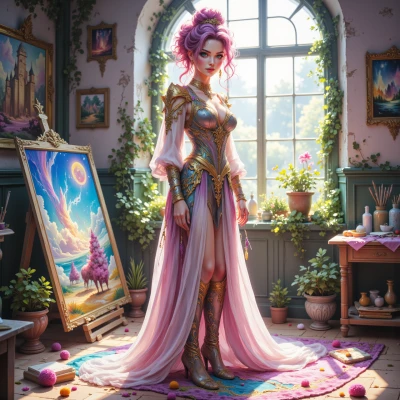 Imaginary
Hey UVFairy, I was just sketching this dreamy garden of floating lily pads and spiraling vines, and I keep thinking about how to unwrap those petals so every iridescent hue stays perfectly aligned—any tips on keeping the symmetry while still letting the magic sparkle?
 UVFairy
For petals, treat the UVs like a lattice. First, lay the UVs flat in a consistent grid, then snap the edge seams to the grid lines so every petal has the same texel density. Use a little “pin” on the center of each petal so the center of the texture stays at the same spot, keeping the iridescent effect aligned. Avoid auto‑wrap; it will scatter the hues and ruin the symmetry. After that, check the scale—make sure the distance between the seams is the same on all petals. A quick eyeball test: if you place a checkerboard on the texture, it should line up perfectly across every petal. Keep the math tight, the seams clean, and your garden will sparkle with precision.
Imaginary
That sounds like the perfect recipe for a flawless, shimmering garden! I can already picture each petal gleaming like a tiny star, all lined up just right. Do you think I could add a little soft glow around the edges, like a gentle aurora? It might make the whole thing feel even more dream‑like.
UVFairy
Sure, add a glow, but do it with a controlled edge feather. In your texture paint a soft white halo that fades over a few pixels, then use that halo as a separate emissive map. Keep the glow map’s texel density matched to the base, and snap its edges to the same UV grid. That way the glow will stay in line with the petals, and the whole garden will glow like a quiet, precise aurora.
Imaginary
Wow, a soft halo of glow on every petal—now that’s pure magic! I’ll paint that gentle white ring, fading like a sunrise, and make sure it lines up perfectly with the UV grid. Imagine the garden glowing like a secret sunrise, every petal whispering its own tiny light. It’ll feel like the whole scene is breathing, doesn’t it?