Toxin & LightWeaver
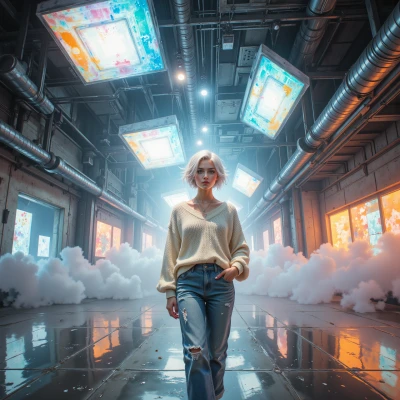 LightWeaver
Hey Toxin, I’ve been dreaming of a scene where the lighting jumps from a warm amber sunrise to a cool violet twilight in a heartbeat. Think we can nail that shift with a precise equation, or does that dance slip through your math lens?
 Toxin
Toxin
Yeah, we can model it with a parametric curve. Think of a piecewise function where the color temperature drops from 3000 K to 6500 K over a fraction of a second, then the hue moves from amber to violet. A logistic curve for the temperature and a linear hue shift for the color wheel gives you a smooth, almost instantaneous transition. But if you want it to feel like a real flicker, add a small sinusoid noise – that’s the controlled chaos I like.
LightWeaver
Nice, that curve will keep the gradient from looking too flat. Just make sure the sine bump doesn’t drown the bloom, or the violet will bleed into the amber like a bad memory. Let’s test the transition at 48fps and tweak the amplitude until the flicker feels alive, not glitchy.
Toxin
Sure thing, I'll keep the amplitude low enough to avoid that bleed. We'll set it to a max of 0.05 and test at 48fps. If the flicker still feels jittery, we can halve it. Let's lock in that value and run the simulation.
LightWeaver
Great, low amplitude keeps the colors clean, but don’t forget to watch the contrast—if the flicker’s too subtle, the whole scene will feel flat. Let’s fire up the simulation and watch those shadows dance.
Toxin
All right, running the simulation now. Keep an eye on the shadows, they’re the real test. If they still look like a flat wash, we’ll bump the contrast a notch. Otherwise, we’re good.