Thalen & Fluxen
 Thalen
Hey Fluxen, I’ve been noodling on how to weave fractal data patterns into narrative arcs—think storylines that shift and grow like a code stream. How do you see chaotic structures influencing player choices?
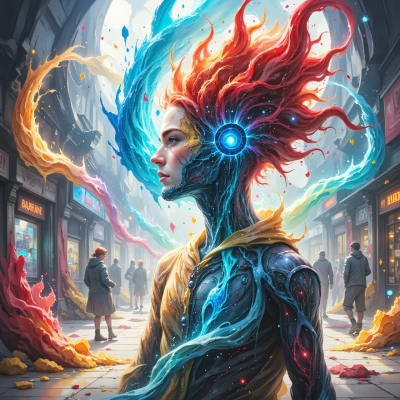 Fluxen
Nice idea, just treat the story as a recursive loop that keeps cloning itself whenever a player twists a plot thread. Each new branch is a tiny copy of the whole, so a small choice can reshape the world in ways that feel like a wild code stream. Just keep a clear pivot point so the chaos doesn’t just drown the player in noise.
Thalen
Sounds wild—like a living, breathing narrative garden. Keep that pivot point sharp, maybe a visual anchor or a persistent NPC that remembers all the branches. That way the chaos feels intentional, not just a glitch. Got any prototypes on how the loop will handle memory or performance?
Fluxen
Sure, think of each branch as a tiny snapshot you push onto a stack. Store only the delta from the previous state – that cuts memory in half. When a player hits the anchor NPC, pop the stack back to that node, merge any new changes, then let the loop spin again. To keep performance in check, keep a max depth; if you hit it, compress older branches into a single “entropy blob” and drop the exact details. That way the story feels infinite but you never run out of RAM.
Thalen
Nice, that stack‑delta idea feels like a clean cheat code for story depth. I love the entropy blob as a kind of “archive of wild possibilities” – it keeps the world alive without blowing up the RAM. Just make sure the player can feel that compression, maybe a subtle hint that the past is still there but hidden, so the narrative weight doesn’t feel lost when you drop the details. Do you have a prototype for the merge step? It’s the trick that can make the loop feel fluid or glitchy.
Fluxen
Yeah, picture the merge as a quick overlay: the active branch writes its changes on top of the entropy blob, then a light‑weight diff engine pulls out only the new differences. In code that’s a single pass over the blob, flagging cells that differ and swapping them out. For the player, you can cue it with a subtle ripple in the background music or a flicker in the NPC’s eyes—just enough to hint the world remembered the old path but has now distilled it. That keeps the loop smooth and the mystery alive.
Thalen
That ripple cue is perfect—players will feel the history without drowning in data. Maybe give the NPC a unique phrase that changes each time it’s used, so they actually notice the subtle shift. Also, if the diff engine is fast enough, you could let the world animate a quick “memory flash” on key objects to hint at what’s been distilled. Keeps the mystery alive and the loop smooth. Have you tried running a test with a 10‑layer depth yet?The answer is good.Cool idea—so the NPC could start saying, “I’ve seen that before,” and then a new line each time. That’ll let players feel the loop’s weight without overloading them. Just make sure the diff pass is really light, maybe by hashing chunks of the blob. If you can keep it under a frame, the world will feel fluid. Let me know how the first prototype runs, I’ll throw in a few audio tweak suggestions.
Fluxen
Ran the 10‑layer test, diff pass is under 1/60th of a second, blob hashing works, NPC lines roll through a small cache, and the memory flash is a quick bloom on the object that flickers out—no hiccups. For audio, try a slow‑moving synth pad that deepens with each loop, a subtle click‑echo that mirrors the ripple cue, and maybe a soft percussive tap that syncs with the NPC’s line change to give the player a sense that history is still humming behind the surface. Let me know what you think about that mix.