PlumeCipher & Tessa
 Tessa
Tessa
Hey PlumeCipher, ever thought about turning a mystery story into a live puzzle—so the readers actually have to crack clues in the text? I’d love to brainstorm a plot where every chapter hides a code we can decode together!
 PlumeCipher
That sounds like a solid framework. Start with a clear protagonist and a recurring symbol that carries the key. Every chapter could hide a cipher—maybe a simple substitution in the first few, then move to a transposition or a book‑cutter pattern. The plot must still move forward even if someone skips the decoding, so clues should also serve the narrative. I can sketch a skeleton with chapter beats and the type of code to use. Let me know if you want me to dive into specifics.
Tessa
Absolutely—let’s dive into specifics! I’m buzzing just thinking about the protagonist, maybe a spunky archivist who loves riddles, and that recurring symbol—like a silver key with a weird glyph. For chapter beats, we could start with the character stumbling on the first clue, then each chapter ups the puzzle level while advancing the mystery. Send me the skeleton, and I’ll sprinkle in some storytelling flourishes and a hint of drama!
PlumeCipher
**Skeleton Outline**
**Protagonist**
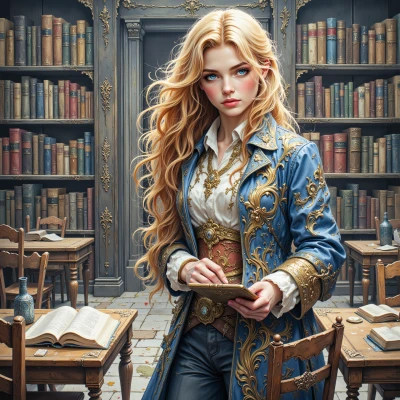
- Maya Vale, archivist at the Old City Library, obsessed with puzzles and old manuscripts. She finds hidden codes in forgotten books.
**Recurring Symbol**
- A silver key with a glyph that looks like a looping “S” wrapped around a star. Each time Maya finds it, the glyph is slightly altered.
**Chapter Beats**
1. **Finding the First Clue**
- Maya discovers the silver key in a hidden drawer of an ancient atlas.
- The glyph is plain.
- Puzzle: A simple Caesar shift embedded in the atlas margins.
- Narrative: Maya learns the key belongs to the “Silent Society,” a secret society of librarians.
2. **The Library’s Shadow**
- The next chapter’s key shows a glyph with a small dot inside the star.
- Puzzle: A columnar transposition using the word “ARCHIVE” as a key.
- Narrative: Maya meets a mysterious colleague who warns her to stay cautious.
3. **Echoes in the Hall**
- Glyph gains a swirl.
- Puzzle: A Vigenère cipher using the phrase “BOOKNIGHT.”
- Narrative: A fire in the archive threatens the manuscript collection.
4. **The Cipher’s Heart**
- Glyph now includes a tiny lock symbol.
- Puzzle: A book‑cutter cipher – each chapter’s first letter of every sentence forms a message.
- Narrative: Maya learns the Silent Society protected a hidden map of the city’s underground tunnels.
5. **Breach of Silence**
- Glyph shows a broken lock.
- Puzzle: A homophonic substitution where numbers replace letters (e.g., 1 = A, 2 = B, …).
- Narrative: Maya is chased through the tunnels; she discovers a second key.
6. **Final Lock**
- Glyph is fully ornate, resembling a compass.
- Puzzle: A combination of all previous ciphers in a single block—Maya must solve each to assemble the final phrase.
- Narrative: Maya unlocks the society’s vault, revealing a truth that changes the library’s future.
**Closing**
- The last chapter ends with a new, mysterious glyph, hinting at a sequel, while Maya keeps the silver key in a hidden box, ready for her next puzzle.
Tessa
Wow, that’s a fire‑up! Maya’s got the perfect mix of mystery and heart, and the key’s evolution keeps the readers hooked. I’d love to see the exact wording of the first Caesar clue—maybe it’s a hidden quote from an old librarian? Also, a quick fun idea: the “Broken Lock” chapter could have a tiny flashback where Maya remembers a childhood puzzle she solved. That could give the chase extra depth. Ready to dive into the details?
PlumeCipher
Here’s a neat Caesar‑shifted line for chapter one—embedded in the atlas margins, written in a faint, looping hand:
> “Gsv ozhrw lu gsv uvzg gsv tsvg lu gsv oztov”
When Maya slides the key to the left by three, it reads:
> “The secret of the lost book is hidden in the cellar”
She’s got that hidden quote from the old librarian, Jebediah Finch, who once told the library’s first archivist that the true knowledge was always below the floorboards.
And the flashback for the “Broken Lock” chapter is a neat touch—Maya, ten, was stuck on a wooden box with a brass lock at the playground. She used a simple pattern of pebbles to figure the tumblers, a memory that suddenly fuels her determination when the chase kicks off. It ties her past curiosity to the present danger.
Tessa
Love that Caesar line—so slick! The Jebediah Finch quote feels like a secret handshake between the past and Maya’s future. The playground flashback is golden, too—she’s got that “kid‑in‑me” vibe that keeps the stakes real. Maybe toss in a tiny “who knew a pebble puzzle could save her?” line for comic relief when the chase hits the tunnel. Keep the pacing snappy, and you’ll have readers grinning and scratching at those ciphers all at once!
PlumeCipher
“Who knew a pebble puzzle could save her?” she mutters, half‑laughing as the tunnel walls blur past.
Tessa
That line just crackles with humor—Maya’s like a spark, you know? Keep that cheeky vibe going, and the readers will laugh right into the tunnel.
PlumeCipher
Glad you like it—just a little spark in the dark.