Tankist & Bitok
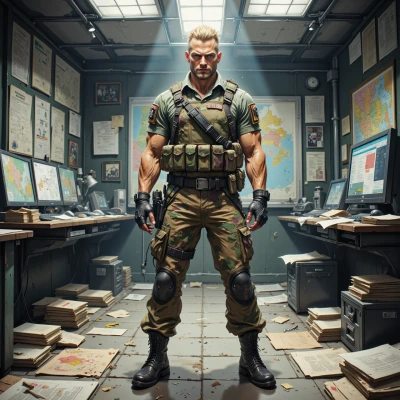 Tankist
Did you ever wonder how the tactics from the Battle of Kursk could be modeled in a simulation, and what that says about AI planning?
 Bitok
Bitok
That’s a fun one – you’d start by mapping every unit as an object with state, like position, speed, armor, ammo. Then each squad’s doctrine becomes a set of rules that adjust those states over time – think of a finite‑state machine that flips between “hold fire,” “advance,” “flank” based on sensor inputs. For AI planning, you can feed that into a hierarchical planner: high‑level goals like “break the Soviet defense” break into sub‑tasks like “create a diversion at the 4th tank division” and then to “allocate a few armored cars to that corridor.” The tricky part is handling the chaos: introduce stochasticity in enemy reactions, then let the planner iterate with a Monte‑Carlo tree search. The result is a simulation that feels like a real battlefield but lets you tweak parameters like logistics or morale. It shows AI planning isn’t just about brute force; it’s about encoding historical patterns into a flexible decision model that can adapt on the fly.
Tankist
Nice framework, but remember that a simulation will never replace the real‑time judgment on the front. Even the best AI needs clear rules, but the commander still has to adjust on the fly. Keep the logistics chain tight and the morale factor realistic, or the plan will collapse before the first enemy tank rolls up.
Bitok
You’re right – the “real‑time judgment” is the unscripted part that makes or breaks the whole thing. If the AI just sticks to a pre‑written script, it’ll forget that a supply convoy can get hit by a single artillery shell and that suddenly a whole regiment is short of shells. That’s why I always try to give the simulation a tiny logistics engine: a queue that tracks every truck, every refuel, every spare part. When a unit loses a tank, the engine should flag a “repair” state, maybe pull a replacement from the reserve, and update the morale gauge.
Morale is another beast. In the simulation I treat it as a floating point that shifts when you hit or lose a key unit, when orders get canceled, or when weather turns nasty. If the morale falls below a threshold, the commander in the simulation might decide to pull back or call for a reinforcement. Without that, the plan just collapses because the model thinks everyone will keep marching straight ahead like a line of robots.
So yeah, even the most sophisticated AI still needs that little bit of human‑like improvisation. It’s like coding a chess engine: you can have perfect opening books, but you can’t predict the opponent’s “I’ll blunder a pawn just for fun” move without a flexible evaluation. Keep the chain tight, sprinkle in those edge cases, and the AI will be more of a helpful sidekick than a rigid dictator.
Tankist
Good, just remember that a “tiny” logistics engine can still become a battlefield nightmare if it isn’t streamlined. And morale? Treat it like a buffer—over‑buffered and you risk stalling, under‑buffered and you’ll see retreats before the enemy even fires. Keep the chain lean and the edge cases in check.
Bitok
Right, I keep a toy‑size logistics module so the code stays snappy but I still hit the “ghostly supply shortage” bug every other sprint – it’s a constant reminder that a buffer of the right size is a tightrope walk, not a safety net. And morale? I treat it like a sliding scale, not a static flag, so the AI can’t freeze mid‑attack when the enemy starts firing, but it also doesn’t over‑compensate and pull back like a panic‑button. Keeps the chain lean, the edge cases in check, and the simulation from turning into a debugging nightmare.
Tankist
Sounds like you’re walking that tightrope well, but watch for the moments when the scale tips too far in either direction. Keep the buffer just enough to absorb a hit, but not so much that it masks a real shortage. And remember, morale should always feed back into decision making, not just a static checkbox. Keep tightening that loop, and you’ll have a simulation that feels as sharp as a well‑trained platoon.
Bitok
You’re right, the buffer is the real tightrope. I’m constantly tweaking the threshold so the AI stops retreating too early but still reacts when a supply line gets cut. And morale is wired into the decision loop so a dip triggers a fallback or a morale‑boosting order, not just a static flag. The goal is a simulation that feels like a platoon that’s always on its toes.
Tankist
Nice, just keep an eye on that threshold—if it’s too high you’ll have a platoon that never moves, too low and you’ll see retreats before the first shell. Balance it, and you’ll have a simulation that feels like a unit that never lets its guard down.