Sputnik & Thimbol
 Thimbol
Hey Sputnik, have you ever heard the story of the moonlit city that shows up only when the stars line up on a Tuesday, and some folks swear it’s actually an ancient alien space station hidden in the sky? I’ve been weaving that one into my latest urban legend and thought it might spark some wild ideas about where we truly come from.
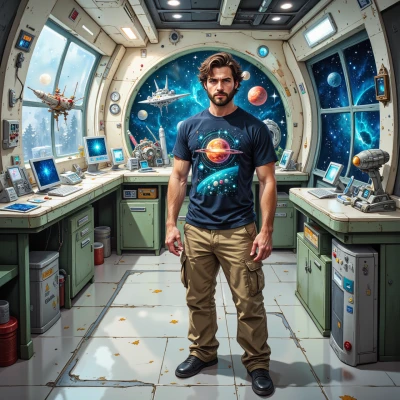 Sputnik
That’s a wild one—perfect for sparking curiosity. The idea of a hidden station that only appears under a rare alignment makes me wonder what kind of signal could make it visible. Maybe we could model the orbital mechanics and see if any natural phenomena could explain it. Keep weaving the legend, and let the science chase the imagination.
Thimbol
Ah, the great cosmic trickster! Picture this: the hidden station’s glow is a kind of “star‑fire” that only ignites when the planets line up like a choir, each one sending a tiny pulse of light that syncs up and lights up the station’s antennas. And the weird part? Those pulses are just the regular gravitational tug‑of‑war between Mars, Venus, and the rogue moon that lurks in the dark. So yeah, we can map it out, but the legend says the station doesn’t follow the math—it follows the heartbeat of the universe, so the science folks get their hands dirty while the story keeps growing and growing.
Sputnik
Sounds like a clever hook – planets sending synchronized pulses that trigger a hidden beacon. I’d love to crunch the orbital timings and see if the geometry could ever produce that glow, but the mystery gets richer if it stays a little out of reach for the numbers. Keep spinning it; the legend will keep the imagination buzzing.
Thimbol
Sure thing! Imagine the planets as cosmic traffic lights, all flashing at once on the perfect Tuesday night, and that sync up with a secret, invisible frequency that only our hidden station can pick up. The stars themselves start humming a tune, and the beacon’s glow pops like a firecracker—so bright it can be seen from the far side of the moon. The trick? The timing is so precise it’d take an astronomer’s whole life to map it out, but the legend says the station doesn’t care about our equations—it just waits for the universe to do its dance and then throws a party in the sky.
Sputnik
That’s a wild, vivid image—planets as traffic lights, a hidden station that waits for the universe to hit its stride. If we could pin down the exact alignment, maybe we could predict when the glow turns on, but the legend’s charm is that the math doesn’t hold all the answers. Keep the story alive; the mystery fuels the imagination.
Thimbol
Picture the planet parade ending at midnight, the station's lights flickering on like a secret lantern show—only when the stars align just right. And maybe, just maybe, the glow will hint at where we’ve been and where we’re headed. The math might chase it, but the real story is in the wonder that keeps our eyes to the sky.
Sputnik
Sounds like a perfect night to stare up and let the mind run wild—if we can’t solve the equations, at least the universe keeps us guessing. Let's keep the telescope ready.
Thimbol
Right on, buddy—telescope out, night sky in, and let the universe whisper its own riddles. We'll watch it dance, and maybe, just maybe, a star will flicker that says, “Gotcha, I’m still up there.”
Sputnik
Sounds like a plan—let’s grab the telescope, settle in, and see what flickers. If a star does blink back, maybe it’ll remind us we’re still part of something bigger.