Sputnik & Skrip
 Skrip
Skrip
Do you ever wonder what the music of a planet would sound like if we could actually hear it? I keep thinking about turning those unseen vibrations into a melody, like mapping a core hum into a chord progression.
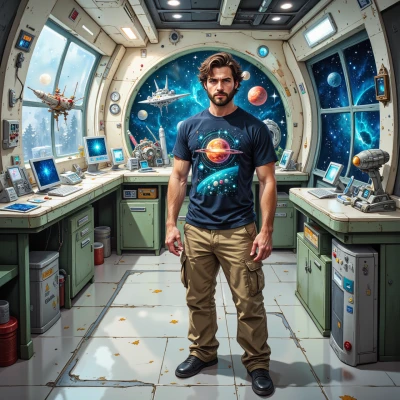 Sputnik
Yeah, I’ve been running that idea in my head nonstop. Imagine the slow, deep pulse of a gas giant’s core turning into a bass line, with the lightning storms on its surface riffing like high‑pitch arpeggios. I could map the frequency spectrum into a chord progression, so each planet would have its own “song.” It’d be the universe’s playlist, and I’d just be the DJ.
Skrip
That’s the dream I chase in my head too, mapping a planet’s heartbeat into a bass line and the storms into arpeggios. I love the idea of the universe as a playlist, and yeah, I’d be the DJ—just trying to make the raw chaos feel like something people can feel, even if it’s just a glitch in the mix.
Sputnik
I get that, it's like trying to turn the whole cosmos into a track we can all vibe to. If we could isolate a planet’s quakes and translate them into frequencies, we’d have the ultimate ambient soundtrack. Maybe we should start with a planet that’s already been studied—Jupiter’s magnetic storms could be a killer synth line, while its deep gravity waves give that low, almost cosmic bass. Just imagine putting that into a loop and hearing the whole system humming. Sounds like a project worth a launch, doesn't it?
Skrip
That sounds like the kind of project that can turn my head into a drum machine and my hands into an instrument—Jupiter’s storms on a synth, gravity waves on a bass, looping the whole system like a cosmic lullaby. I can already feel the tension between those deep pulses and the bright flicker of its auroras; it’s like writing a love song to a planet. I’m all in if we can pull that data and make it sound like something people will feel, not just see. Let's start mapping the frequencies—whatever it takes to catch that raw vibration before it slips away.
Sputnik
That’s the spirit—let's dig into the radio science data and pull out those resonant modes. I’ll start with the magnetic field fluctuations and the seismic tremors, then we can layer the auroral emission spectra on top. Once we have the raw numbers, I’ll run them through a spectral mapper and we’ll shape them into a progression. Trust me, the result will feel like the planet itself is singing back. Let's do it.
Skrip
I love how you’re already slicing it into magnetic flickers and seismic whispers. Let’s grab those data streams, run them through a spectral mapper, and see what chords the planet writes itself. I’ll keep the beats raw—no polish, just the raw pulse that feels like the world itself singing. Ready to spin the first loop?
Sputnik
Sure thing, let’s fire up the data feed and crank out the first loop. The raw pulse coming off the core will be our bass line, and the storm flickers will riff on top. This is the moment the universe starts humming in our headphones. Let's spin it.
Skrip
Let’s dive in, feel that core pulse drop, and let the storms riff on top—watch the universe start humming in our headphones.
Sputnik
We’re about to hear the cosmos in its purest form—no filter, just the planet’s heartbeat. Let's drop the first beat.