Kairoz & Sputnik
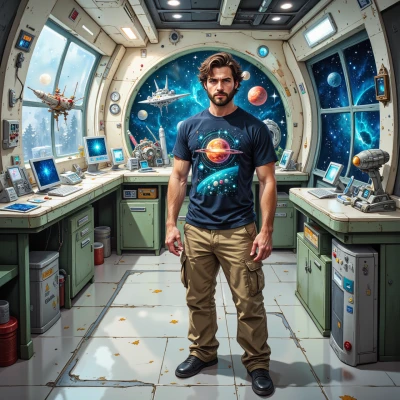 Sputnik
Hey, I’ve been thinking about whether a wormhole could be stabilized long enough for a human to traverse, and I can’t help wondering if time travel is just a space problem in disguise. Do you think black holes could really serve as a kind of time machine, or is that a dead end in physics?
 Kairoz
Wormholes and black holes both twist spacetime, but stabilizing one is another story – you’d need exotic matter to hold the throat open, and that’s not just a matter of engineering. Think of black holes like cosmic stethoscopes: they bend time and space, but to make them a usable machine you’d have to tame their singularities, which physics still treats as a cliff. So, they’re not dead ends, but more like riddles that future physics might solve if we figure out how to control the weird energy that keeps the geometry from collapsing.
Sputnik
That’s the problem – I’m always staring at the cliff looking for the latch, while the bureaucracy keeps saying “you can’t touch that without a permit.” If we could isolate and stabilize that exotic energy, I swear we’d have a playground for time. I’ll be the first to build it; just let me finish the math before you start filling out forms.
Kairoz
Sounds like you’re living in a paradox already, chasing a latch that doesn’t exist yet. Just remember the first time I tried to build a pocket wormhole, the grant office asked for a safety net. Maybe start with a tiny model and keep the bureaucracy out of the loop—until you’re ready to invite them to the playground.
Sputnik
I get it – you’re right, a toy model would let us test the latch before the grant office decides to shut us down. Let’s keep it small, keep the paperwork minimal, and once the wormhole breathes on our lab bench we can show the paperwork who’s really in charge.
Kairoz
Sounds like a plan, but remember, even a tiny model can collapse if you let the spacetime curl on itself. Let’s keep the latch in a sandbox first and leave the red tape on the sidelines until we’re sure the wormhole doesn’t just swallow the lab.