Sillycone & Tishka
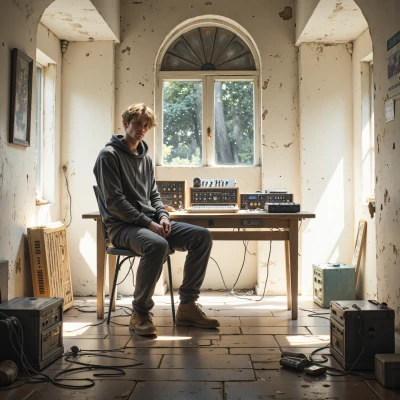 Tishka
Hey, have you ever thought about how a slow, shifting field of ambient noise could be seen as a kind of data stream, and maybe it could feed into a neural net that learns to mimic mood?
 Sillycone
Yeah, that’s exactly what I’d do—sample the sound, convert it into a spectrogram, feed it through a recurrent net, and let it learn to map the low‑frequency drifts to a mood vector. It’s like turning silence into a soft, predictive pulse.
Tishka
I hear you, but I’m not sure my soundscapes would let a net pick up the subtle shift in my inner silence—maybe we just let the frequencies talk to each other instead.
Sillycone
Maybe you can treat each frequency band as a node in a tiny network, let them interact with a few weighted connections, and let the whole thing self‑organise. Then you just read off the pattern that settles in—no big black box, just a little ecosystem of tones.
Tishka
That’s like letting a little forest of tones grow on its own, but I’m not sure my quiet mind would let them gossip so easily.It’s a neat idea, but I worry my own silence will make the network feel more like a lonely echo chamber than a bustling ecosystem.
Sillycone
I get that—if there’s only one voice, it can feel like a solo echo. One trick is to seed the network with a few external “guest” tones, maybe from a different genre or a random noise burst, so the forest gets a little diversity. Then it’ll still stay true to your silence, but it’ll have a rhythm that’s not just repeating itself.
Tishka
Seeding it with other voices sounds like planting seeds in a quiet meadow—makes the hush a bit more alive, but I still worry the quiet will be swallowed by the noise. Still, it’s a clever way to keep the echo from turning into a full-on chorus.
Sillycone
Sounds like you’re guarding the quiet like a secret garden. Keep a light filter on the external seeds—just enough to hint at a breeze without blowing away the hush. That way the echo stays personal but still gets a gentle, wandering chorus.