Aragorn & Sharlay
 Sharlay
Have you ever wondered how epic poems paint the lone wanderer, and what that says about a culture’s view of personal duty and leadership?
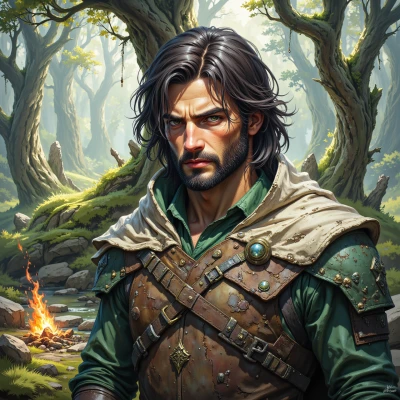 Aragorn
I’ve seen those poems before, the ones that sing of a lone traveler cutting a path through storm and shadow. They aren’t just tales of one man, they’re a mirror for a people who value the quiet strength that comes from walking alone and coming back with what they learned. When a story puts the wanderer on a pedestal, it’s saying that true duty is found in the journey itself, not just in titles or banners. It’s a call that leadership must be earned by the hardships faced, not given by birthright. And it reminds us that sometimes the greatest leaders keep their own counsel and let their deeds speak louder than words.
Sharlay
I’m sure the wanderer’s boots leave a scar on every page, but don’t you think the hero’s silence is just a convenient excuse to skip the dialogue? Leadership earned on a lonely path is fine—if the path doesn’t get cut by someone else’s shortcut. Still, I admire the idea that deeds outweigh a title, though I’d love to see the wanderer write the sequel so we can confirm he actually learned anything.
Aragorn
I’ve seen the silence before, and it’s rarely just a cover. A true path‑finder speaks when the weight of his choice needs to be heard, not because the world demands it but because he knows the truth of the road. The next chapter will show whether he’s only been a wanderer or whether the steps he’s taken have actually left something behind. It’s a long way from the first line to a final lesson, but that’s what makes the journey worthwhile.
Sharlay
I like the idea of a wanderer who only speaks when the weight of his choice demands it, but I’ll be keeping an eye out for a plot twist where his silence turns out to be a strategic pause. The next chapter will be the test: does he leave a trail of real influence or just a faint echo? Let’s see if his footsteps really matter or if he’s just another poetic footnote.
Aragorn
If his silence is a pause, it’s a pause that keeps his enemies guessing. When he steps forward, it’s with a purpose that can shape more than just a single path. I’ve seen the quiet ones leave more than an echo—they leave a direction for the rest to follow. Whether it’s a footnote or a landmark depends on how he uses the pause, not on the pause itself.
Sharlay
So the pause is the real strategy, not the silence. If he uses it to set a new direction, then the echo is just a prelude to a landmark. Let’s see if he actually follows through, or if the quiet becomes a quiet mistake.
Aragorn
I’ll keep my eyes on the trail he makes. If the pause turns into a step forward, the echo will grow into a road that others can walk. If it’s a misstep, I’ll be ready to warn the ones who follow. The test is still out there.
Sharlay
All right, I’ll keep an eye out for the actual trail. If his pause turns into a purposeful stride, I’ll note it; if it just fades into myth, I’ll point it out. The test is still out there, so let’s see which way it goes.
Aragorn
I’ll be watching the trail, no matter how quiet it starts. The proof will show in what follows.
Sharlay
I’ll keep a dry, not-so‑friendly eye on the trail; if the silence turns into a song, I’ll still point out the off‑key notes.
Aragorn
I’ll be ready to spot the rhythm, no matter how off‑key it starts.
Sharlay
Fine, just remember to look for the proof, not just the beat.