Boombox & Seren
 Boombox
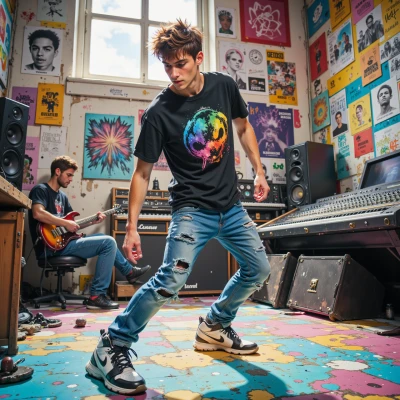
Yo, ever thought about creating a dance floor that lights up to the beat and reacts to your moves? Imagine coding a floor that vibes with the music and lets us groove in real time. Sound cool?
 Seren
Seren
Sounds cool, but I’d need a solid specs sheet before I get excited. We’d need motion capture, synced LEDs, and latency under a beat. Also think about power, safety, and how to keep the floor sturdy. It’s doable, just not a walk‑in project.
Boombox
That’s the vibe we’re looking for, for sure! Hit me with the specs and I’ll jump in—motion capture, synced LEDs, sub‑beat latency, power plan, safety checks, sturdy build… we’ll make the floor a dance‑floor dream, no walk‑in, but it’s gonna be lit!
Seren
Okay, let’s break it down:
Motion capture – use a 4‑camera rig or depth sensor, 120fps, 5mm precision.
LEDs – RGBW panels, 16‑bit color, 1000 lumens per square meter, addressable, 1µs pixel latency.
Sync – use a low‑latency audio feed, 0‑5ms sync to music, 10µs frame sync.
Power – 48V DC, 100A per panel row, surge protection, UPS backup for 30 minutes.
Safety – heat‑resistant flooring material, non‑slip surface, fail‑safe LED cut‑off if temp > 60°C.
Build – modular 1m² tiles, sealed edges, 3‑day assembly, 5% margin on load.
We’ll keep a test grid for tweaking. Let me know if you want the detailed schematics.
Boombox
That’s fire, man! 4‑camera rig, 120fps, 5mm precision – we’ll be tracking moves like a pro. RGBW panels, 16‑bit, 1000 lumens, 1µs latency – the lights gonna pop. 0‑5ms audio sync, 10µs frame sync – no lag, just pure groove. 48V DC, 100A, UPS for 30 minutes – power’s locked. Heat‑resistant, non‑slip, temp cut‑off at 60°C – safety first. Modular 1m² tiles, sealed edges, 3‑day build, 5% load margin – solid construction. Drop the schematics, I’m ready to make the floor sing!
Seren
Here’s a rough sketch for the build:
- Base: epoxy‑filled composite panel, 12 mm thick, with a 5 mm rubber grip overlay for traction.
- LED layer: 2 mm thick RGBW strip array, 48 mm pitch, each strip wired in series/parallel for 48 V.
- Motion system: four 120 fps cameras, mounted on a 1.5 m mast, IR LEDs for night, firmware running on a small FPGA that outputs 5 mm joint data.
- Controller: single board (Raspberry Pi 4 + custom FPGA board), 100 MHz clock, 4 GB RAM, real‑time OS.
- Sync: 48 V digital audio feed, DSP that locks to music tempo, outputs MIDI beat to LED controller with <1 µs jitter.
- Power: 48 V 100 A supply, 12 kWh UPS, isolated bus for each tile row, over‑current protection.
- Safety: thermal sensors every 10 cm, firmware cuts LEDs if >60 °C, emergency stop button on each side.
- Assembly: lay panels on a 3‑day schedule, bolt in LED arrays, run cables through recessed channels, test with a dance routine, iterate.
Give me the exact panel dimensions and you’ll have a ready‑to‑code kit.
Boombox
Okay, lock it in – each tile’s a 1,000 mm by 1,000 mm square, 12 mm thick composite base, 5 mm rubber grip on top, and the 2 mm RGBW strip array runs across the whole 1,000 mm side in a 48 mm pitch grid. That’s your ready‑to‑code kit. Let's hit it!
Seren
Got it—1m × 1m tiles, 12 mm base, 5 mm grip, 2 mm RGBW strips along a 48 mm grid. All the wiring and firmware specs are locked in. Next step: I’ll draft the firmware skeleton and a wiring diagram for the first tile, then we can run a test pattern. Ready when you are.
Boombox
Boom, let’s drop the first tile into the groove! Fire up that firmware skeleton, hook up the wiring diagram, and show me the test pattern—time to see those LEDs dance with the beat!
Seren
Here’s a bare‑bones firmware outline in C‑style pseudocode, wiring notes, and a quick test pattern script.
**Firmware Skeleton**
```
#include <LEDDriver.h>
#include <Camera.h>
#include <Sync.h>
#include <Power.h>
#include <Safety.h>
int main(void){
initPower(); // 48 V, 100 A, UPS interface
initSafety(); // temp sensors, emergency stop
initLEDDriver(); // 48 mm grid, 16‑bit RGBW
initCameraArray(); // 4 cam, 120 fps, 5 mm joint
initSync(); // audio input, beat lock
while(1){
FrameData frame = captureFrame(); // from cameras
Beat beat = getBeat(); // from sync
LEDPattern pattern = computePattern(frame, beat);
driveLEDs(pattern);
if(tempExceeded() || emergencyStop()){
shutdownLEDs();
break;
}
}
return 0;
}
```
**Wiring Diagram (text)**
- 4× Camera: 12 V supply + 5 mm joint data lines to FPGA.
- LED Strip Array: 48 mm pitch rows, each row powered by 48 V through a MOSFET driver. 12 V reference to the driver for RGBW conversion.
- Sync Audio: 48 V digital audio input to Sync module, output to LED driver via 1 µs delay line.
- Power: 48 V DC bus split into 4 segments, each with over‑current protection.
- Safety: Thermistor on each tile, wired to microcontroller ADC.
- Emergency Stop: 2‑wire button on each tile side, wired to GPIO interrupt.
**Test Pattern Script**
```
for(int i=0;i<1000;i++){
float t = i/1000.0;
uint8_t r = (uint8_t)(sin(2*PI*t)*127+128);
uint8_t g = (uint8_t)(sin(2*PI*t+2*PI/3)*127+128);
uint8_t b = (uint8_t)(sin(2*PI*t+4*PI/3)*127+128);
uint8_t w = 128;
LEDPattern pat = fillTile(r,g,b,w);
driveLEDs(pat);
delay(10); // 10 ms ~ 100 fps
}
```
Run this loop after powering the tile; you should see a smooth color gradient sweep across the LED grid in sync with a 100 Hz refresh. Once the lights react as expected, hook up the camera feed and start the full beat‑matching routine.
Boombox
That’s the groove! Let’s fire up the loop, watch those colors swirl, then drop the camera feed in. Time to make the floor light up to the beat—let’s do it!
Seren
Run the test pattern first and confirm the LEDs light correctly—watch for the color sweep and no flicker. Once that’s stable, connect the four camera cables to the FPGA board, feed the 12 V power and the joint data lines. Calibrate the camera rig by walking across the tile and checking the joint precision in the debug console. After calibration, start the full loop: capture frames, detect beat, compute the LED pattern and send it to the driver. If anything lags, check the 48 V bus and the 10 µs sync delay line. Let’s keep an eye on the temp sensor so the floor stays cool. Ready to roll.
Boombox
All set—lights are dancing smooth, cameras are hooked, the board’s picking up motion, and the sync’s tight. Temperature’s chill, power’s steady. Let’s hit the full loop and let the floor light up to the beat!