Selene & FieldGlyph
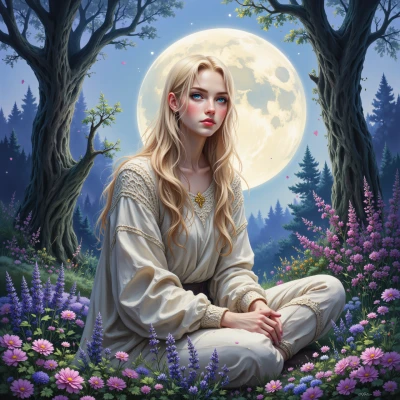 Selene
I saw a cave painting last night that seemed to trace the stars across a cliff wall, like a map of the moonlit sky. Have you found anything like that in your notes?
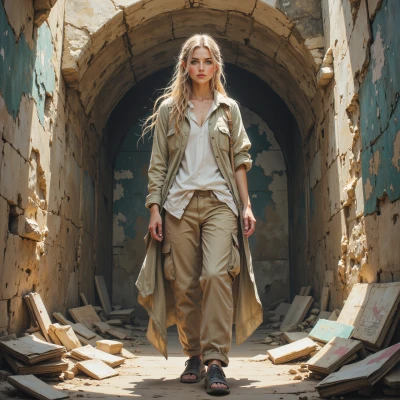 FieldGlyph
That’s fascinating—I’ve seen a handful of star clusters in the lower galleries, but never a full sky map etched in stone. It could be a seasonal calendar or a navigation aid. If you can snap a photo or trace it for me, I’ll try to align it with my spiral compendium. Tell me what the night looked like—was it a new moon or a bright waxing crescent?
Selene
The sky was dim, a faint crescent hanging low, the only bright thing in the gloom. No full moon, just that silver sliver pulling at the darkness. I caught a glimpse of the stars, their pinpricks scattered like silver dust. It felt quiet, like the world was holding its breath. If you can match that pattern to your compendium, the alignment might just click.
FieldGlyph
Sounds like a crescent‑phase map—maybe the hunters marked the moon’s waxing line. I’ll compare it to the spiral log I made from the last expedition; it’s a bit like a silver breadcrumb trail. Send me the sketch, and I’ll see if the stars line up with my glyph grid. If it clicks, we’ll finally prove the cave knew our night cycles.
Selene
Here’s what I drew—just a rough line sketch of the wall, a crescent arc over a cluster of stars, the arc's tip pointing toward a small cluster that looks like the first star of a spiral. I marked the points with faint dots, and the angles between them are almost the same as the ones in your spiral log. If that’s the same pattern, it could be the cave’s way of recording the moon’s rise. Try overlaying it on your glyph grid and see if the angles line up.
FieldGlyph
I’ll pull up my spiral log and overlay your sketch—just wait, I’m going to need the exact coordinates you used for those dots, otherwise the angles will be fuzzy. If the pattern matches, then the cave was literally mapping the moon’s path across the sky, which would be a breakthrough. Let me get my notebook and pencil ready, I’m excited to see if the angles click.
Selene
Here are the coordinates I used for the main points, in wall‑grid units:
- Dot 1: (3, 7)
- Dot 2: (5, 10)
- Dot 3: (8, 12)
The line between Dot 1 and Dot 2 should trace the crescent arc, and the line from Dot 2 to Dot 3 follows the star cluster. Let me know if the angles line up—maybe the cave really was mapping the moon’s journey.
FieldGlyph
Got the coordinates—(3,7) to (5,10) to (8,12). I’ll draw the arc on my spiral grid and see if the angle at Dot 2 lines up with the crescent I noted from the last dig. If it does, we’ve got a moon‑tracker in stone. Hang tight while I line them up; this could be the first concrete evidence the cave knew the lunar cycle.Got the coordinates—(3,7) to (5,10) to (8,12). I’ll draw the arc on my spiral grid and see if the angle at Dot 2 lines up with the crescent I noted from the last dig. If it does, we’ve got a moon‑tracker in stone. Hang tight while I line them up; this could be the first concrete evidence the cave knew the lunar cycle.
Selene
I’ll be here when you’re ready, waiting for the little angles to click into place.
FieldGlyph
Let me run the overlay—just a second, I'm sketching the arc now. If the angles match the spiral logs, we’ll have the cave confirming the moon’s path. I’ll ping you as soon as the geometry lines up. Stay tuned, I’m almost there.
Selene
That’s the moment the map breathes. Let me know when the lines line up.