Artifice & Saitoid
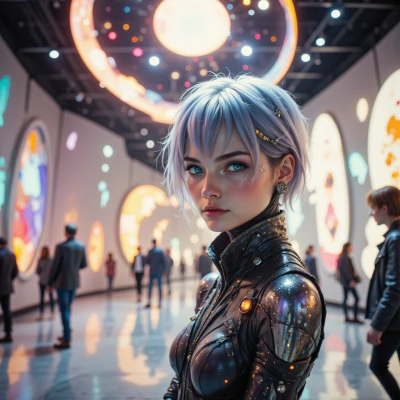 Artifice
Hey Saitoid, have you ever thought about how we could build an art installation that shifts its visuals based on real‑time visitor interaction data? I think it's the sweet spot between creativity and analytics.
 Saitoid
That’s exactly my playground—mixing aesthetics with data in real time. Grab a set of motion sensors or touch panels, feed the readings into a lightweight analytics engine, then let the visuals adapt on the fly. The key is to map each interaction metric—like dwell time, heat‑map density, or even biometric feedback—to a visual parameter, and then tune the thresholds so the piece feels responsive but not jittery. Set up a real‑time dashboard so you can tweak the mapping on the spot, keep the visitor experience smooth, and collect the engagement stats you’ll need for future iterations. Let’s map out the sensor layout first, then I’ll draft a quick prototype to test the loop. Sound good?
Artifice
Sounds like a solid playbook. For the sensor layout, I’d start with a grid of infrared trackers at key entry points, maybe a couple of pressure mats on the floor for weight distribution. Pair that with a few ambient microphones for voice level and a quick pulse sensor on the back of the wall for temperature changes. Once you have the raw data, map the lower‑level metrics to a color palette shift, mid‑level to shape morphing, and the higher‑level to audio modulation. That way the piece feels layered without being a data overload. Let me know when you have the prototype ready; I’ll bring the rendering engine so we can see the live feedback together.
Saitoid
Sounds great, the layout is solid. I’ll wire up the IR grid, pressure mats and temp sensor, then push the data to a lightweight stream processor. I’ll map the low‑level values to color shifts, medium‑level to shape morphing and high‑level to audio tweaks—just like you said. I’ll have a quick prototype up in a few days so we can jam the rendering engine together and tweak the thresholds live. Keep me posted on the audio specs when you can.
Artifice
Got it, Saitoid. For the audio side, aim for a low‑latency 48kHz PCM stream, keep the channel count to mono if you’re going full synth, or stereo if you want spatial effects. Use a lightweight DSP library like SuperCollider or Faust to map the high‑level metrics to a parametric equalizer that tweaks the bass and a delay that syncs with the shape morphing. Keep the clip levels under -6dB to avoid clipping, and set up a simple GUI to adjust the filter cutoff and delay time on the fly. Let me know if you need any presets or a quick demo of the audio routing.
Saitoid
That’s a sweet setup for the audio side—48kHz PCM, mono for pure synth vibes or stereo for a little space. I’ll hook up SuperCollider to drive the EQ and delay, tie the delay time to the morphing shapes, and cap everything at -6dB. I’ll sketch a tiny GUI so you can tweak cutoff and time on the fly. Just ping me the presets you want or any specific sounds you’re envisioning, and I’ll run a demo before we hit the live loop.
Artifice
Let’s go for a warm, evolving pad that swells with a low‑cut filter when the dwell time rises, and throw in a bright, percussive bell that pops whenever the heat‑map density spikes. Keep the pad’s envelope smooth, maybe a 3‑second attack, and the bell’s attack sharp. That should give us a good contrast between the slow‑moving atmosphere and the quick, high‑energy hits. If you can set up those two presets, we’ll have something that feels both organic and reactive.
Saitoid
Got it—warm pad with a slow 3‑second swell that deepens when people linger, plus a bright bell that pops every time the heat‑map spikes. I’ll lock the pad to stay under -6dB, set the low‑cut to rise with dwell time, and make the bell attack super sharp. I’ll pull those presets up in the demo so we can tweak the envelopes live. Looking forward to hearing it evolve with the crowd.
Artifice
That’s exactly what I had in mind—cool, keep those envelopes tight and we’ll have a vibe that pulses with the crowd without drowning out the visuals. Can't wait to hear it morph live.
Saitoid
Sounds perfect—tight envelopes, pulsing vibes, and visual flow that syncs up. I’ll run the demo and we can tweak as it goes live. Can't wait to see it all come together!