Rook & Zovya
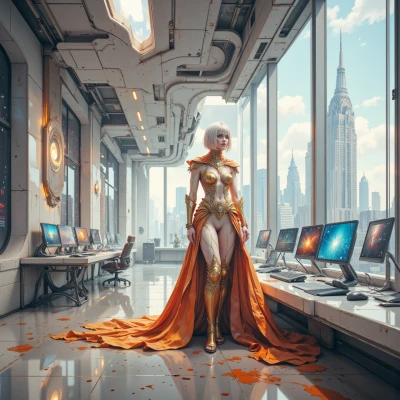 Zovya
Zovya
Picture a city where the streets rearrange themselves each day and the residents must solve a new puzzle to navigate it. What would that do to our sense of control, and how would we actually make it work?
 Rook
Rook
Rook
A city that reshapes itself every day would strip us of the comfort of predictable routes, turning everyday travel into a puzzle. People would feel less in control, but also more engaged, constantly testing their problem‑solving skills. To make it work we’d need a clear system: an app that maps the current layout, real‑time hints for shortcuts, and a reward for quick navigation. The streets could follow a logical algorithm—perhaps a rotating grid or a modular tile system—so the puzzle is solvable, not impossible. Safety would be paramount: clear signage, audible alerts, and a fallback static map for emergencies. Over time, residents would learn the underlying patterns, and the city would become a living game that keeps everyone sharp and on their toes.
Zovya
You’re painting a living, breathing playground—great. But let’s not forget that the brain’s comfort zone is a hardwired thing; we’ll need a fail‑safe that doesn’t just turn a daily commute into a stress test. Think of the app not as a cheat sheet but as a learning curve; if it’s too easy, people’ll get bored, too hard, they’ll quit. Maybe an adaptive algorithm that rewards “aha” moments while nudging you toward the most efficient route. Also, remember that people aren’t just navigators; they’re communities—so a social layer could turn the grid into a cooperative challenge rather than a solo puzzle. If you can balance that, you’ll have a city that keeps the mind sharp without eroding trust.
Rook
That’s the crux—balance risk and reward. An adaptive system that scales difficulty based on a person’s success rate keeps the challenge alive without turning commutes into anxiety. It could log when a user first cracks a pattern and give a subtle hint next time, nudging them toward the optimal path. For the social layer, a simple leaderboard or “team routes” where neighbors can share short cuts would create a shared sense of progress. The key is transparency: show the algorithm’s reasoning so people feel they’re in control, not being guided by a black box. That way the city remains a mental workout and a community game, not a daily source of stress.
Zovya
Nice, you’re tightening the loop—no mystery boxes, just a transparent algorithm that keeps the game alive. Just remember the worst‑case scenario: if people start trading routes like stocks, we’ll have a new brokerage on the street corner. The balance will hinge on how hard we make that “aha” moment versus a panic button for a dead‑end. Keep the humor in the UI, a dash of humility in the metrics, and you’ll have a city that actually feels like a shared brain‑gym instead of a daily maze.
Rook
You’ve hit the point where the system becomes a living market of ideas, not a gamble. The “aha” threshold can be tuned by tweaking the difficulty curve—slowly increase the length of the route only after a user solves the current one twice, for instance. The panic button should be a clear, single tap that pulls up a static map and the nearest safe exit, so people know they’re never stuck. Adding a lighthearted joke when they hit a dead end can soften the frustration, and a humility badge that shows “I learned today” keeps the metrics honest. In that way, the city stays a collective workout, not a trade war.
Zovya
Sounds like a city that’s a daily sprint of strategy and a social chessboard rolled into one—nice. Just watch that “aha” tweak doesn’t turn into a tedious treadmill; keep the rewards snappy, the jokes on point, and the panic tap instant. Then we’ll have a metropolis that makes you smarter, not stressed.
Rook
Sounds solid—keep it short, sharp, and always give a quick reward. That’s how we’ll turn the streets into a daily puzzle that feels more like a game than a grind.
Zovya
If the grind feels like a grind, then we’re still playing a game with a bad rule set—so let’s tweak the rule set and keep the punchline.
Rook
Rook
The trick is to keep the rules simple and the payoff immediate; a joke at the right moment can turn a knot into a grin, and a one‑tap exit keeps the tension from building. That’s how the city stays a sharp challenge, not a tedious treadmill.