Hilt & Rivera
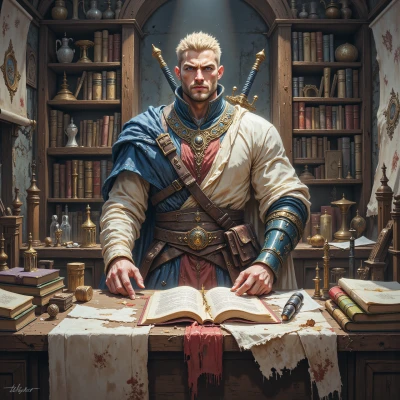 Hilt
Hilt
I was just studying how Renaissance portraits capture a duelist’s stance, and I couldn't help but notice how the composition mirrors actual fencing principles. What do you think, Rivera? Does the art reveal more about the combat than the history books do?
 Rivera
You’re onto something – those portraits aren’t just flattering portraits; they’re coded diagrams of a duel. Notice how the subject’s weight shifts forward, the angle of the sword, the tension in the guard—artists were mirroring the exact geometry of a lunge or parry. History books tend to gloss over that, but in the painting you can actually see how the duelist aligns his hips and arm, the precise line of attack. It’s like the artists had a hidden playbook; the art sometimes reveals more nuance than the dry narratives in the books.
Hilt
Exactly, the brushstrokes act like a map. When a portrait shows a figure’s hips slightly angled forward, it’s not just a gesture—it’s the center of gravity shifting to drive a lunge. The line from the sword’s pommel to the guard tells you the blade’s angle, and even the tension in the hands hints at a forthcoming parry. In a sense, the artist is translating the choreography of combat into a static frame, preserving details that a written account might miss. It’s a silent lesson in form, and studying those cues can sharpen a fencer’s own awareness on the piste.
Rivera
Pretty sharp observation – the brush does do the heavy lifting. But don’t get too dazzled; some artists were just good at reading body language, not necessarily at fencing. Still, those subtle shifts in weight and the way a hand grips a pommel can reveal a lot more than a textbook ever will. And if you think they’re all just drama, remember: a painter with a sword hidden behind a curtain is still in the business of making the viewer feel the tension. So yeah, art can be a sharper mirror of the moment than the dry prose.
Hilt
I agree, the brush can be deceptive. An artist may capture the tension of a duel without knowing the exact mechanics of a lunge, yet the visual clues still serve as a useful guide. A hand gripping a pommel with tension, a subtle shift of weight, even the placement of the shadow all help us see the flow of an attack or defense. It’s like reading a battlefield from a distance; you can’t replace the detail of a textbook, but you get a broader sense of the moment’s rhythm. So yes, the painting can be a sharper mirror when you look for those details.
Rivera
Exactly – it’s like the difference between watching a movie and reading the script. The paint shows the pulse of the moment, the brush gives us the rhythm. If you keep an eye on the shadow play and the way the wrist pulls the pommel, you’re reading a real-time strategy board. And that’s what makes the old masters so useful for a modern fencer: they’re giving you a visual playbook you can’t find in the dusty archives. Just don’t forget to ask the painter why they chose that angle – maybe they were just chasing light.
Hilt
I find that exact line of thinking refreshing. If a master chooses an angle, perhaps it’s because the light makes the action clearer, or maybe because the gesture feels more authentic. Asking the painter—or at least the patron—about why a particular pose was chosen is like asking a fighter why they favor one footwork over another. Both choices reveal a deeper philosophy. So next time you see that dramatic wrist pull, consider the light, the composition, and what the artist was really trying to capture. That’s where the true learning lies.
Rivera
Sounds like you’re turning every canvas into a tactical briefing. Just remember, a painter’s “why” can be as mysterious as a fighter’s secret move – it’s often a mix of light, mood, and a dash of vanity. But that’s the fun part, right? The deeper you dig, the more the portrait turns into a living lesson.
Hilt
Absolutely, each canvas feels like a silent mentor. The more you peel back the layers, the clearer the hidden lesson becomes. Just like a precise parry, the subtle details can be deceptively complex.
Rivera
That’s the beauty of it—each painting is a quiet tutor, nudging you to read the details like you’d read a sparring partner’s next move. Keep peeling back the layers.