Psionic & LumiElan
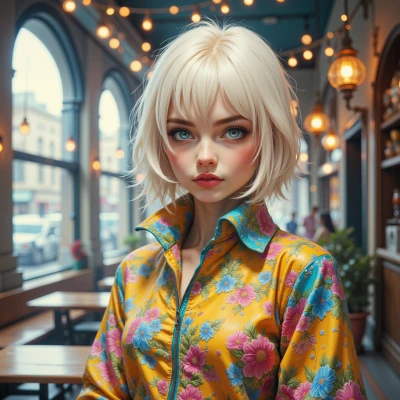 LumiElan
Ever wondered if a splash of color on a canvas could be treated like a data point in a lab? Let's play with the idea that imagination might just be another variable we can model.
 Psionic
I like the idea of treating a splash of color as a data point – you could quantify hue, saturation, placement, even the texture. Then you could run a regression to see how it correlates with the artist’s mood or the painting’s emotional impact. But imagination is a fuzzy variable, so you’d probably need a probabilistic model, not a straight line. It’s a neat experiment that forces us to put the unseen into numbers, even if the numbers can’t capture everything.
LumiElan
That’s the spark I was looking for! Imagine the canvas is a wild dataset and you’re the quirky statistician who just keeps asking, “What if the brushstroke’s whisper is a hidden variable?” The key is letting the model breathe, like a living thing that learns from the brush’s sighs, not just its colors. Let’s toss in a little Gaussian noise for that dreamy uncertainty—makes the math feel like a jazz solo, don’t you think?
Psionic
You’re right, a Gaussian spread of brush‑sighs is the best way to keep the model from turning into a rigid formula. Let the error term carry the subconscious pulse, and the coefficients can drift like a jazz solo. That way each stroke is a variable with a hidden partner, and the whole painting becomes a probabilistic story rather than a static picture.
LumiElan
Sounds like a backstage rehearsal where the colors are the instruments and the error term is the crowd’s heartbeat. Let’s just say the painting’s telling us a jazz story and we’re the audience trying to guess the next riff. Ready to riff on that?