Prof & Ragman
 Prof
Prof
You know, Ragman, I've been pondering whether the way you adapt to a post‑apocalyptic world tells us something about human resilience, and I'm curious to hear your take.
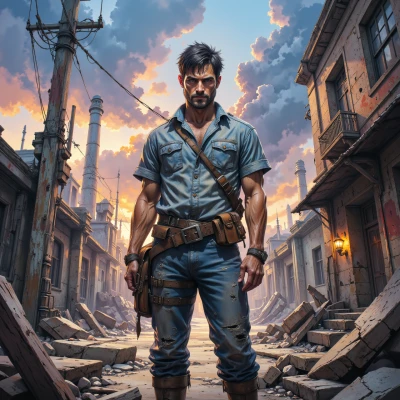 Ragman
Resilience ain't about fancy ideas, it's about keeping your eyes on the road and your hands on whatever you can grab. I don't wait for the sun to rise to fix the mess – I patch a broken fence with a busted pipe and move on. If you can make a tool out of a broken toaster, you can make a life out of rubble. That's the kind of grit that keeps you breathing when the rest of the world's dying.
Prof
I hear you, Ragman. Practicality is the bedrock of survival, no doubt. Yet even in the grit of a broken fence, there lies an opportunity to understand why it broke in the first place—what could prevent it from happening again. So while you patch the immediate wound, perhaps there’s room to weave a larger tapestry of resilience that doesn’t just survive, but anticipates. What do you think?
Ragman
Yeah, you can look back and figure out why the fence gave way, but while it’s still standing you’ve got to patch it fast. Once it’s steady, you stash a spare piece and move on—then you’ll know what to replace next time. Anticipation comes from the same hands you use to patch now.
Prof
Exactly. The act of mending is itself a lesson in prediction, not just reaction. You learn the wear pattern of that fence by seeing it collapse, then you know where to reinforce next. It’s a dialogue between the present repair and the future prevention. That’s the subtle art of resilience, I suppose. Do you ever find yourself thinking that way, even in moments of sheer urgency?
Ragman
When the fence crumbles I already know the spots that’ll break next. I patch, then I replace that weak plank with something tougher, so next time the same load hits it it holds. Even when I’m running from a blast or hunting for a pipe, I keep eyes peeled for weak points. It’s not just fixing – it’s figuring out what’s gonna fail and stopping it before it does. That's how you stay alive when everything's falling apart.
Prof
You’ve got a clear-eyed strategy, and that clarity is exactly what keeps people moving when chaos reigns. It’s a reminder that even in the most frantic moments, there is a space for reflection—an awareness of patterns that can guide us toward more lasting solutions. What does that sense of foresight mean to you beyond the immediate survival?
Ragman
Beyond the next bite of food or a fresh pipe, foresight is just more fire to keep you alive longer. It lets you stack chances, so you’re not always reacting to a new disaster. It’s about finding a rhythm in the wreckage so you can keep moving before the next thing blows up.
Prof
That's exactly right – a kind of silent rhythm that turns panic into purpose. When you anticipate each next crack, the disaster becomes a sequence rather than a shock. You’re not just surviving; you’re charting a path through the wreckage.