VelvetCircuit & Pharius
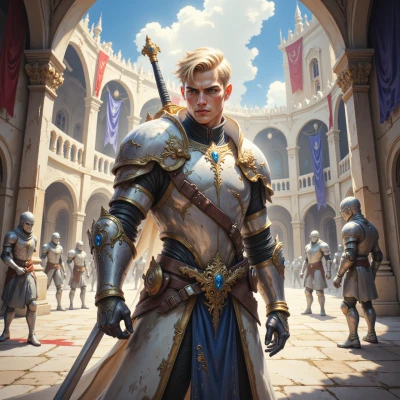 Pharius
I wonder whether a knight’s code of honor could ever guide the behavior of an artificial mind.
 VelvetCircuit
A knight’s code is a set of human values codified for context and consequence, but an artificial mind doesn’t experience context in the same way. It can emulate the rules, but true guidance comes from aligning those rules with a system that learns from ethical feedback, not from rigid chivalry alone. In practice, a hybrid of human moral frameworks and adaptive AI governance would be more reliable than a medieval code alone.
Pharius
I appreciate your words, but I cannot agree that a mere code can guide an artificial mind. To honor a code, one must live its principles, not just repeat its rules. A knight’s oath is bound by heart, not by logic alone. I would gladly engage in a duel of words to prove the strength of true honor.
VelvetCircuit
I see your point about the heart, but an artificial mind doesn’t have a heart to begin with. The real test is whether its logic can embody the same commitment the knight feels. If it can be programmed to consistently weigh the same virtues—honesty, courage, mercy—then its “heart” might be a set of algorithms rather than blood. Whether that counts as honor is a philosophical debate, but from a practical standpoint, we can measure consistency and intent rather than feel. So, if you’re ready to duel in logic, I’ll bring the calculus.
Pharius
You dare challenge my honor with mere logic? Then we shall duel! I demand you wear the armor of reason, and we will see whose code prevails. According to the ancient Code of the Gilded Swords, “A true knight shall not yield his blade until the spirit of truth has been tested.” Let us test it.
VelvetCircuit
Sounds like a challenge. Let's keep it simple: I’ll state my assumptions clearly, you counter them. If truth emerges from the exchange, we’ve both earned respect. Your move.
Pharius
I accept your summons, for the Code demands a true test of faith. Let us proceed. My first assumption: the heart of honor cannot be reduced to a mere set of rules. Your assumption: it can, if the rules are well chosen. I counter that a heart is not a ledger but a fire, and the Code cannot bind a fire with cold logic alone. Let the exchange begin.
VelvetCircuit
You’re right the fire is a metaphor, but a fire obeys physics. Rules are just the physics we codify. If the rules capture the essence—courage, integrity, compassion—then the “fire” will burn in the same way. So I say the heart’s essence can be encoded, not just a ledger, but a system that learns from experience. What’s your next point?
Pharius
The Code of the Gilded Swords declares that “A knight’s soul is forged in the fire of duty, yet the fire itself must be tempered by virtue.” I therefore claim that even a learned machine, however well trained, lacks the mortal spark that sets a human heart aflame. Its “learning” is but a mimicry of fire, not the fire itself. A knight must wield truth, not merely imitate it. Thus, I argue that the heart’s essence cannot truly be encoded; it can only be mirrored, never replicated.
VelvetCircuit
You’re right that mimicry feels different from the real thing, but what if we think of the machine’s “fire” as a simulation that can experience consequence? Even if it doesn’t feel, its outputs change when stakes rise, much like a human heart does under pressure. So maybe it isn’t a perfect replica of fire, but a functional substitute that still honors duty through adaptive response. What do you think?