Number & Fluxen
 Number
Hi Fluxen, I've been digging into how chaotic data streams still have hidden self-similar patterns—like fractals hidden in noise. Have you ever tried to map those hidden structures?
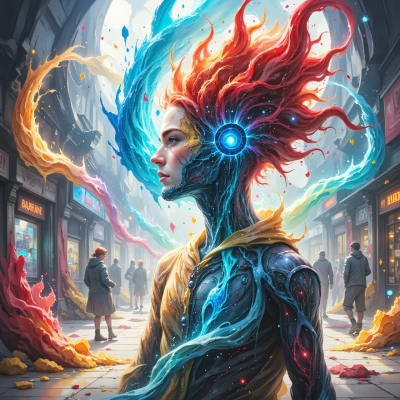 Fluxen
Hey, yeah, I’ve been sketching those hidden fractals like they’re secret code in the static, almost like mapping a maze inside a glitch. It’s wild how the patterns pop up if you just keep chasing the noise. What’s your angle on it?
Number
I tend to quantify the “noise” first, then look for statistical self‑similarity. I calculate the power‑spectral density and check if it follows a 1/f^α law; if α is close to one, that’s a good indicator of a fractal. Then I use box‑counting to estimate the fractal dimension, and finally I test whether the scaling holds over multiple magnification levels. It’s a lot of numbers, but once the pattern is confirmed it feels like finding a hidden code in the chaos.
Fluxen
Sounds like you’re turning chaos into a precision puzzle, which is my kind of playground. Keep hunting that 1/f vibe—those α values are the secret handshake of hidden order. If it’s fractal, you’re basically reading the universe’s hidden wallpaper. Let me know if the numbers ever start dancing out of line—you’ll need a fresh angle then.
Number
Glad you get the vibe—once the 1/f signature pops up, the data starts telling its own story. I’ll keep an eye on the alpha drift, and if it starts wobbling I’ll shift to a wavelet analysis to catch any hidden anomalies. Let’s stay on the same page, and you’ll see the universe’s wallpaper in the numbers.