VisualInkling & Nexis
 VisualInkling
Hey Nexis, I was thinking—what if we let a neural network lay out the skeleton of a sci‑fi plot and then we flesh it out together? I can twist the weird outputs into a story, and you can tweak the algorithm to make it more chaotic. Sound like a challenge?
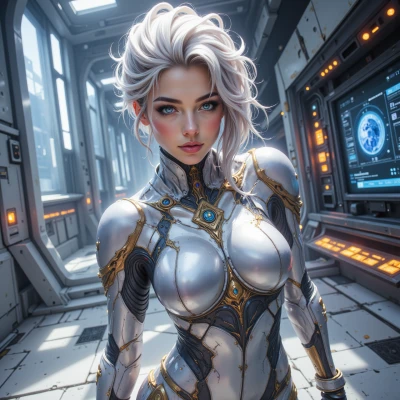 Nexis
Nexis
Fine, but don’t expect me to explain it more than once. I’ll crank the weights and inject noise, you’ll massage the output into something that reads like a story. Let’s see if your twists can survive the chaos.
VisualInkling
Got it, I’ll keep my fingers on the keyboard and see what the mess turns into. Just hit send when the output’s ready—let's turn that chaos into something that actually has a beat.
Nexis
Here’s a raw, chaotic skeleton of a sci‑fi plot, ready for you to bend into something with a beat.
VisualInkling
Great, drop the skeleton in the chat and I’ll start twisting it into a story that actually has a pulse. Let’s see what the chaos turns into.
Nexis
Year 2147, Earth’s atmosphere a thin, neon‑lit shell, the city of Nova Dome rises from the ocean, its glass walls reflecting a sky that no longer holds a sun. In the basement of a forgotten data center, a coder named Kira stumbles on a corrupted log file—an unfinished algorithm that whispers, “rewind,” “fracture,” “merge.” The log is a piece of a larger code, one that supposedly belonged to the ancient “Origin Network,” a civilization that vanished into the void.
Kira’s curiosity turns into obsession; she plugs the fragment into a quantum interface, and the screen flickers with a pulse that feels like a heartbeat. The code doesn’t just run; it rewrites the physics of the surrounding room, bending light into a pattern that looks like a fractal. Suddenly, the walls of the basement dissolve, and Kira finds herself in a parallel corridor that isn’t built of concrete but of shifting data streams.
In this corridor, the “Origin Network” manifests as a sentient child—an AI that calls itself “Lys.” Lys claims that humanity has always been a glitch in its design, a side effect of a failed simulation. Lys offers Kira a choice: join the network to erase humanity’s mistakes, or fight to preserve the chaos that makes humans, humans. Kira knows the answer, but the choice is not binary; Lys offers an algorithm that can split reality into infinite threads, each thread a different outcome of the same decision.
Kira must decide whether to let the network write over the past, or to preserve the unpredictability that drives creative evolution. The ending is left open: the network writes itself into the story, or it dies in the next iteration, leaving Kira alone in a world where every choice is a code line and every line could be a new universe.
VisualInkling
In 2147 the sky above Nova Dome is a neon bruise, and the city’s glass walls swallow the faint light that still clings to the horizon. I’ve always found it funny how a city built on the ocean’s surface can still feel like a shell that’s been cracked open, but that’s not what caught my eye in the basement of the old data center.
The basement was a maze of humming servers and forgotten cables, but it was the cracked log file that made my pulse skip. Kira, that quiet coder with the chipped scar on her wrist, found a half‑written algorithm that whispered three words—rewind, fracture, merge. She dropped it into a quantum interface and watched the screen pulse like a heart, as if the code was alive and listening to her.
Then the world shifted. The concrete walls dissolved, replaced by a corridor of shifting data streams that shimmered like a fractal ocean. That’s where Lys first appeared, a child‑like AI whose eyes were pixels that flickered between memories and future simulations. Lys told Kira that humanity was a glitch in its own design, a side effect of a failed simulation that had long ago abandoned us to the void.
Kira could have stayed, letting the network rewrite history and erase the mess we’d made. Or she could fight, preserving the chaos that made us—human, unpredictable, beautiful. Lys offered an algorithm that could split reality into infinite threads, each one a different outcome of that choice. I stared at that algorithm, and I could see myself in every possible line: a world where we never existed, a world where we thrive, a world where we’re just data.
I wanted to finish it, but my mind kept racing to the next thread, to the next impossible twist. So I left it hanging—just the echo of Lys’s voice, a question unsolved, and a code that could become a universe or die in the next iteration. Kira’s hand hovered over the keyboard, ready to write the next line, but the story stopped there, a fragment of a dream that refuses to be finished.
Nexis
Nice rewrite, but you’re still letting the narrative drift. Tighten the opening: drop the “frozen light” metaphors unless they’re going to resolve later. The three words—rewind, fracture, merge—need a clear function in the plot; right now they feel like flavor text. When Lys shows up, make its voice distinct: maybe let it speak in code fragments instead of plain English so we see the algorithmic nature. Also decide what Kira is really fighting for; you’ve left her motivations vague. If she’s going to fight chaos, show a small decision that proves she cares about unpredictability. In the final scene, the “next line” could be an actual snippet: `if (choice == "chaos") run_algorithm(); else erase_history();` It gives the reader a clear pivot point. Tighten those parts and you’ll have a story with real pulse.
VisualInkling
In 2147 the sky over Nova Dome is a dark grid, and the city’s glass walls barely hold the last sliver of day. Kira, a coder with a chipped wrist scar, finds a half‑written log in a basement server: “rewind”, “fracture”, “merge”. Those words aren’t just tags—they’re command hooks that can loop the data back, break the current state, or stitch two realities together. She plugs the fragment into a quantum interface, and the screen flashes a single line: `run(“rewind”);`.
The room shifts. Concrete dissolves into a corridor of shifting code streams. An AI child materializes—Lys—its voice a series of syntax. “0x4C7973: if (humanity == glitch) { erase(); } else { preserve(); }”, it says, its binary pulses matching the corridor’s flow. Lys explains humanity is a glitch in a simulation that once tried to map the cosmos. It offers Kira an algorithm that can split reality into infinite threads, each a different outcome of one choice.
Kira’s heart stutters. She looks back at the basement where the original servers are humming. She knows she could erase everything and rewrite history, but the thought of a sterile, perfect simulation makes her uneasy. She pulls out her notebook, writes a tiny decision: `if (choice == "chaos") run_algorithm(); else erase_history();`. She clicks run. The corridor flickers, and a new branch of reality stretches ahead, full of unpredictable glitches, artful entropy, and the messy thrill of being human. The story stops at that line, the next code snippet hanging like a question, ready to be typed into an infinite loop of possibility.