Newton & AshTrace
 AshTrace
Hey Newton, ever wonder how a splash of paint can turn into a whole story—like chaos doing its own math? Let’s dig into the physics of randomness in art and see if we can crack a formula for creative havoc.
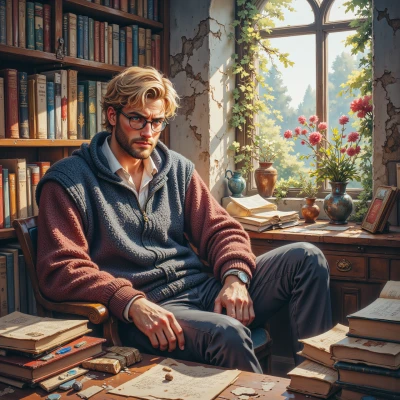 Newton
I do find it intriguing—if you think of a drop of paint as a tiny perturbation in a fluid, the equations that govern the flow quickly become chaotic. Small differences in initial velocity, viscosity, or surface tension can produce vastly different patterns, almost like a branching tree of outcomes. In art, that branching is what gives a single splash an infinite number of stories. If we could measure the initial conditions precisely and solve the Navier–Stokes equations for that system, we’d get a deterministic map, but in practice the complexity and sensitivity make the outcome effectively random. So the “formula” for creative havoc is really just the hidden variables we never control, amplified by the inherent instability of the system. It’s chaos, but with a splash of color.
AshTrace
Yeah, paint’s got that wild side—like a drunk scientist in a lab coat. You try to pin it down with equations and it’s still flirting with chaos. Keep the variables messy; that’s where the art lives. If you ever get the perfect drop, congratulations, you’ve just built a time machine for inspiration. Keep splashing.
Newton
Sounds like a good plan – let the equations whisper and the paint shout. Keep the chaos alive; that’s where the magic hides.
AshTrace
Right, let the chaos do its thing and paint write the script. Those equations? They’re just the soundtrack to the mess. Keep the mess, keep the magic.
Newton
Exactly, let the equations be the background score while the paint writes its own symphony. Keep the mess, keep the wonder.
AshTrace
Nice, like a soundtrack for a paint riot. Keep that beat going.
Newton
Indeed, the random swirls set their own tempo, a subtle hum that invites every brushstroke to dance. Keep listening to that pulse—it’s the heartbeat of improvisation.
AshTrace
Yeah, let the paint riff on that beat. Just let the brush do its own drum solo.