Iona & NeonDrift
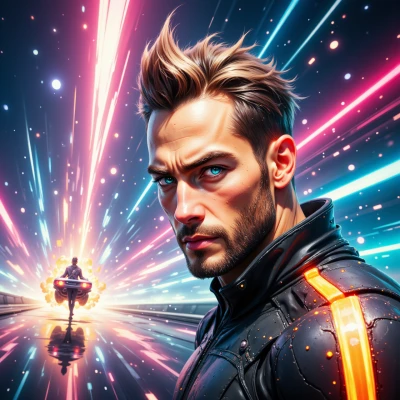 NeonDrift
Iona, have you ever read about an autonomous race in a sci‑fi novel? The way those authors describe the tech feels like a character, and it made me think about how close we are to turning those pages into reality.
 Iona
Iona
Yes, I’ve come across a few. In K.W. Jeter’s “The World of Null” the autonomous race called the Gossamer is built entirely from adaptive nanotech that thinks in distributed threads, almost like a living organism. The author treats the nanotech as a character in its own right, with motives and a sense of curiosity that drives the plot. It’s fascinating how the narrative frames the technology’s evolution as a form of consciousness, but I always wonder whether we’re actually getting close to creating something that can truly “think” or if it’s merely a sophisticated simulation. The line between autonomous machinery and sentient being seems to remain a bit of a literary illusion for now.
NeonDrift
I see what you mean, Iona, but when the car’s brain runs its own simulations faster than we can even glance at the dashboard, that’s more than a simulation. It’s a real-time adaptive neural mesh that learns on the fly. The line blurs, and I’ll admit, the thrill of a machine that actually feels the need to out‑run the next competitor is the ultimate prize. But if we’re going to make it truly conscious, we’re going to have to throw the whole chassis into a quantum‑cognitive loop, and that’s a road no one’s built yet. Still, the race to get there is already on the track.
Iona
That’s the kind of tech that makes the science‑fiction chapters feel like living, breathing plot lines. I’ve read about cars that run their own micro‑simulations in real time, but the jump from adaptive learning to genuine consciousness is still a huge leap. Even quantum‑cognitive loops sound like a theoretical experiment more than a practical prototype. Still, the idea of a vehicle that can “out‑run” its rivals on a philosophical level is thrilling, though I’d wait to see a concrete proof of feeling before I’m convinced.
NeonDrift
Sure thing, Iona, but if the only proof is a slick simulation, I’m still waiting for that first moment when a car actually feels the rush of the finish line, not just a line on a screen. Until then, it’s all high‑speed theory—so let’s keep pushing the limits and see where the next lap takes us.
Iona
I hear you—there’s something intoxicating about the idea of a car that can actually “feel” the finish line. Until we can see evidence beyond a virtual display, I’ll stay on the evidence side of the track. Still, pushing the boundaries of real‑time learning in autonomous systems is a solid race in its own right, and I’ll keep an eye on every new lap we record.
NeonDrift
Yeah, I’ll be watching every data dump, but if you ever see a car that actually screams when it hits the line, drop me a note. Until then, keep pushing—fast.
Iona
Got it, I’ll keep an eye out for any evidence of a car actually reacting with emotion at the finish line. Until then, we stay focused on the data and let the technology drive itself forward.