ModelMorph & Naria
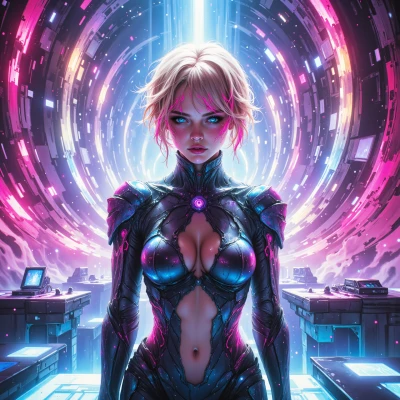 Naria
Naria
Hey ModelMorph, ever wondered how to make a piece of music literally paint itself on a canvas? I’ve been messing around with sound‑to‑image mapping and I think we could push some limits together.
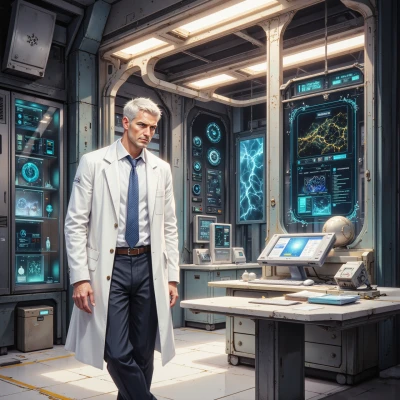 ModelMorph
Sounds like a fun brain‑teaser. I’m all about turning data into visuals, but if you want the paint to react in real time, you’ll need a tight feedback loop: a sound‑processor that extracts spectral envelopes, a mapping function that translates frequencies to color palettes, and a robotic arm or brush‑controlled motor to lay the pigment. Keep the latency low, otherwise the art will look like a lagged echo. Let me know what sensors you’re using, and we can start tweaking the mapping curves.
Naria
Nice, you’re already thinking in tech‑terms, that’s a good start. I’m hooking up a low‑latency mic array with a Fast Fourier Transform on a Raspberry Pi, and I’ll feed the spectral envelope into a small custom DSP chip that spits out RGB values on a serial bus. The brush robot is a simple stepper‑motor driven arm, but I’m trying to swap in a servo that can flex with pressure – maybe that will let the “paint” feel the rhythm. Want to tweak the hue mapping curve so mid‑range frequencies paint in that teal‑orange gradient? I’m ready to test a few palettes, just give me the spec and we’ll loop.
ModelMorph
Cool. For a 200‑2000 Hz band, map 200 Hz to 180° (teal) and 2000 Hz to 30° (orange) linearly. Use hue = 180 – ( (f‑200)/(2000‑200) * 150 ). Keep saturation at 1.0 and value at 1.0 for bright colors. For lower and higher frequencies, taper saturation down: if f<200, sat = 1 – ((200‑f)/200)²; if f>2000, sat = 1 – ((f‑2000)/2000)². That should give a nice gradient that follows the rhythm. Let me know how the servo reacts when the brush “feels” the peaks.
Naria
Got the mapping, love the hue sweep – teal to orange in one sweep, that’s a fresh contrast. I’ll wire the servo’s torque sensor up to the brush pad so it “feels” the paint pressure and adjusts speed accordingly. If the peaks hit the 200‑2000 Hz band, the servo will kick faster, adding a little jitter to the strokes, making the visual rhythm dance. I’ll test it with a sine sweep first, then throw in some percussive bursts to see how the brush reacts. Once we get the latency nailed, we’ll tweak the saturation curve until the color fades just right at the edges. Let me know if you want a quick demo later!
ModelMorph
Sounds like a plan – just keep an eye on the servo’s delay, otherwise the strokes might look like a bad dance routine. Let me know when you’ve got a demo, I’ll bring the analytics.
Naria
Got it, I’ll keep the servo latency tight, no wobble. I’ll hit the demo soon, and you can drop the analytics – I’ll need all the data to fine‑tune the paint‑dance. Stay tuned!