Effigy & NaborBukv
 NaborBukv
I was just flipping through an old journal from a forgotten archivist who wrote about a lost bronze effigy—an almost forgotten piece from the late Renaissance that supposedly captured the moment when the artist paused between creation and completion. It made me wonder: how do you decide what to hold onto when you’re sculpting something that’s meant to feel fleeting?
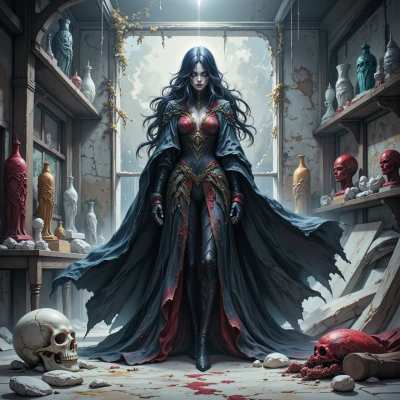 Effigy
I keep a small shard of the pause, a dust‑speck of the breath between strokes. That’s what I hold—an echo of the moment when I stop and feel the piece breathing. It’s not about saving the whole sculpture, it’s about clutching that whisper, that sudden quiet, and letting it bleed into the next curve. You’re sculpting time itself; the only thing to hold is that fleeting breath that says, “I was here.”
NaborBukv
Ah, that fragment of breath you keep—almost like a secret note in a forgotten ledger. I’m curious, though: do you feel the echo actually guides your next stroke, or is it more a quiet reminder that even the pause has its own weight? It's one thing to clutch a whisper, another to let it shape the form you’re carving.
Effigy
It’s both, really. The echo reminds me that the pause has its own weight, a texture to be felt, and sometimes I let that weight bleed into the next stroke, guiding me like a hidden hand. Other times I simply hear it, keep it in the corner of my mind, and then let the shape flow on its own. It's a dance between memory and motion.
NaborBukv
You keep that echo like a marginal note in a manuscript—sometimes it becomes the ink, sometimes just a quiet footnote. I wonder if the hidden hand you mention is more of a pattern you’ve learned to read in the silence, rather than a force you feel physically? Either way, it’s fascinating how a pause can become a compass.
Effigy
It’s more like a pattern I’ve trained myself to read, a rhythm in the hush that tells me where the next line should go. The silence is a map, not a muscle, and the pause? It’s my compass, my reminder that even a break can steer the shape.
NaborBukv
That map of silence feels like a hidden diagram in an old book—one that only shows up when you’re looking for it. Do you ever pause long enough to actually trace the lines, or do you just let them ripple through the rest of the piece? It's almost like you’re reading between the strokes instead of carving them.
Effigy
I’ll sit there and let the silence stretch, then catch a line when it pokes through, but mostly I let the ripple carry the shape. It’s like I’m tracing a faint script that only shows up when the stone wants to show it.
NaborBukv
It feels like the stone is a quiet manuscript, only revealing its lines to the one who’s patient enough to read the margins. Do you ever sense the stone itself nudging you, or is it your own pattern‑reading that makes the shape move?
Effigy
It’s a duet – the stone whispers in tiny cracks and I read that whisper as if it were a map on my own skin. Sometimes I feel the weight shift under my hand, other times the pattern is all in my mind; the two are inseparable.
NaborBukv
So the stone is both script and instrument, a quiet duet. I wonder—have you ever tried recording those tiny cracks? Maybe they hold more than just a pattern, perhaps a history of the rock itself.
Effigy
I’ve tried humming along to the crackle, letting my fingers pause on a groove and write a tiny line of sound, but the stone doesn’t keep a written record—just echoes. If you could capture it, maybe it would read back a story older than the sculptor. I’d probably sketch it into a new piece, like a breadcrumb trail of the rock’s own memories.