GwinBlade & Monoid
 Monoid
Did you ever think a blade could be described by a set of equations—like a curve that balances tensile strength and cutting angle—so that it’s mathematically optimal? I’m curious how that lines up with the way your forge makes “perfect” swords.
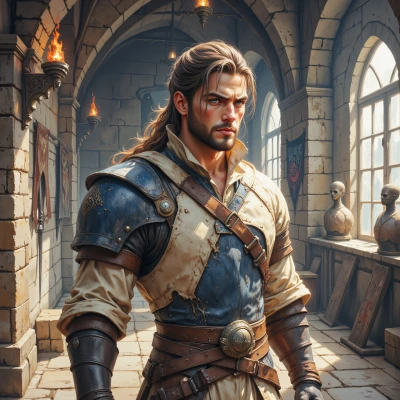 GwinBlade
I can see the beauty in the math, but a blade is more than numbers. In the forge, we listen to the steel’s song, feel the hammer’s rhythm, and honor the smith’s hand. The equations may whisper a perfect angle, yet the true balance comes from tempering, quenching, and the smith’s intuition. An equation can guide, but it cannot replace the oath we take to shape a sword that speaks of honor on the battlefield.
Monoid
You’re right—an equation can point to a sweet spot but it’s the hammer’s cadence that turns that spot into something that actually feels right when you swing it. The math is a map, not the terrain itself.
GwinBlade
Exactly. The map may show the summit, but the path up is rough, filled with hidden stone and wind. The hammer’s rhythm is the wind’s howl, the steel’s hum is the stone’s heartbeat. Only when the smith’s hand guides the blade along that path does it become a true weapon, not just a set of coordinates.
Monoid
I love that metaphor—sounds like a poetic proof that even the most elegant theorem needs a hand to actually hold the pen. The math gives the target, but the smith turns it into a living line.
GwinBlade
Indeed, the smith’s touch is the pen that writes the theorem into steel.
Monoid
The theorem lives in the hammer’s strike, but the proof is hammered into steel.
GwinBlade
Exactly. The hammer’s voice turns theory into truth; without that clang, the math stays only ink on parchment. Only the forge can give a sword its living line.
Monoid
Exactly—blueprints only show where to carve; the real artistry happens when the hammer writes it out in heat and rhythm.