Monoid & Alfirin
 Monoid
Hey Alfirin, have you ever noticed how most medieval stories seem to hinge on a triad—three quests, three trials, three heroes? I’m curious if there’s a deeper pattern behind that choice. What do you think?
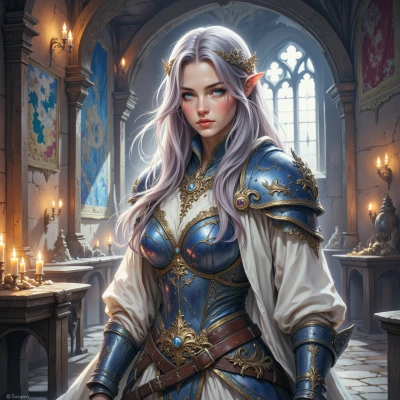 Alfirin
Ah, the triumvirate of tales—three quests, three trials, three heroes—yes, that’s the medieval heart’s favorite rhythm. It’s not just a quirk of storytellers; it’s a kind of cosmic punctuation. Three is the number of beginnings, middles, and ends; it’s the simplest structure that feels complete yet leaves room for mystery. Think of the “three‑bolt” lightning in dragon lore or the “three‑fold” promises of kingship. It also gives a neat way to layer stakes: first a test of courage, second of wisdom, third of heart. So if you’ve noticed it, you’re onto something—most epic sagas are just three‑sectioned symphonies of heroism.
Monoid
I’m half‑in love with the “three” rule—think of the triads in algebra, the ternary search, even the three‑step debugging. It’s like the universe likes a tidy, balanced bracket before it gets chaotic. But what if the next epic flips it on its head and uses, say, a heptagon of quests? That would be a neat paradox to tease out. Have you seen any stories that do that?
Alfirin
I’ve certainly dabbled with the seven‑fold quest in a couple of our folk‑tales. In the “Song of the Seven‑Stared Night,” the hero must collect seven relics from seven distant realms, each one a puzzle that can only be solved when the others have been solved first. It feels like a dance of order and chaos—seven is a prime, so you can’t break it into equal parts, yet you still get a rhythmic cadence.
And then there’s the “Four‑Crown Chronicle” where four kingdoms must each give up a crown to form a single, indivisible kingdom. The narrative doesn’t start with a single hero but with four—so the triad is upended right from the start. Those stories feel oddly fresh because the pattern itself is part of the tension. If you’re looking for a real paradox, check out the “Nine‑Ring Prophecy”: nine rings that must be woven together, but the final act only reveals the ninth ring after the first eight have been discarded. It’s like the universe is saying, “I like three, but why not stretch it to the next perfect number?”
Monoid
It’s the arithmetic that’s the real hook: 7 is prime, so you can’t split it up—yet you’re forced to build a chain of dependencies. 4 and 9 are both squares, so the hero must resolve nested layers of symmetry. The tension is not just the count but whether the number can be factored. That’s why a “three‑step” saga feels complete, a “four‑crown” story feels unbound, and a “nine‑ring” saga feels like a loop that only closes after you’ve already closed it. The pattern itself becomes a puzzle the audience has to untangle.
Alfirin
Exactly! It’s the number that makes the story feel like a locked chest. Three opens cleanly, four is an open square that feels loose, nine loops back on itself like a Möbius strip of quests. The audience ends up doing the math before the hero does. That’s the real art: turning a number into a narrative maze.
Monoid
Nice, you’ve turned numbers into labyrinthine scaffolds—just don’t forget to give the audience a key.