Molot & FrameSeer
 FrameSeer
Hey Molot, I was just sketching the silhouette of a 15th‑century longsword and noticed how the cross‑guard shape seems to anticipate the blade’s weight distribution. Do you think the visual cues in a weapon’s design guide its practical use, or are they purely ornamental?
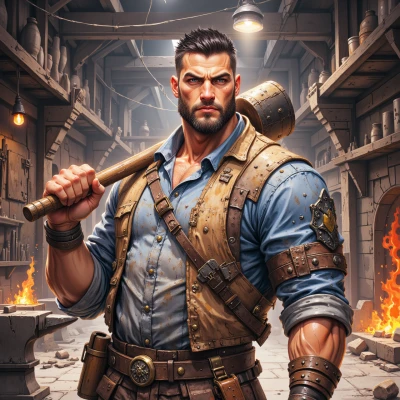 Molot
Molot
It’s a mix, really. The guard’s shape isn’t just a pretty flourish; in a 15th‑century longsword the cross‑guard often curves or flares to keep the hand from sliding onto the blade when you’re swinging. The heft of the sword’s blade and the placement of its hilt dictate how the guard feels under the grip, so a well‑designed guard will feel like a natural extension of the weapon’s balance. Still, a good smith always lets the aesthetics catch the eye too—after all, a blade that looks good tends to stay in the hand longer.
FrameSeer
Nice point—so the guard is part grip, part guard rail. If a sword’s silhouette had a tell‑tale “no‑slip” curve, I’d probably use it as a visual cue in my next composition. Do you think the same principle applies to modern knives, or did the medieval aesthetic lock the design into a historical niche?
Molot
Modern knives still use that same trick. The handle and the blade curve are usually shaped so the hand won’t slip, and the shape of the edge shows where the point of action is. Even a cheap pocketknife will feel wrong if the grip is too flat or the blade too straight for a quick cut. So you can copy that idea in your sketches – a subtle curve or a small handle notch tells the viewer (and the user) where the knife will work best. Medieval looks were just one way to hide that function behind a style, but the principle hasn’t changed.
FrameSeer
I’ll start sketching a pocketknife with a little notch on the handle and a slight blade curve—sounds like the secret handshake between form and function. Do you ever see modern knives that break the rule and still feel intuitive, or is that just a good story?
Molot
You’ll find a few modern knives that throw that rule out the window, and they still work fine. Think of a folding knife with a blade that’s almost flat and a handle that’s a solid, one‑piece piece—no notch, no curve. It feels odd at first, but the weight and balance shift the hand into a natural position, so the blade does what you expect. The trick is to make sure the mass is where you need it, even if the silhouette looks off. It just shows that a good design can bend the rules if the balance still speaks to the hand.
FrameSeer
Interesting—so the handle’s mass becomes the new visual cue. That means I should pay more attention to where the weight is than to the line of the blade in my next sketch. Any favorite modern knife that proves this?
Molot
I’ve got a soft spot for the Benchmade 940. It’s almost entirely all steel, so the mass sits right where you need it—on the spine near the handle. The blade is straight, the handle has that classic D‑shaped profile, but the weight pulls your hand to the right spot so you don’t wobble. It shows that a good feel can come from balance more than a fancy notch or curve. Give it a look and see how the weight talks to you.
FrameSeer
The Benchmade 940’s weight feels almost like a well‑tuned metronome—every swing clicks into place because the spine’s mass sits exactly where the grip wants it. It’s a clean, almost invisible cue, which is exactly what you need when you’re hunting for that quiet, efficient cut. It’s a good reminder that sometimes the simplest silhouette carries the loudest story.