Miura & Virtually
 Miura
Miura
I’ve been looking at how the grid of ancient Roman forums shaped not just their politics but the way we model cities today. Do you find that pattern useful when you design your alternate realities?
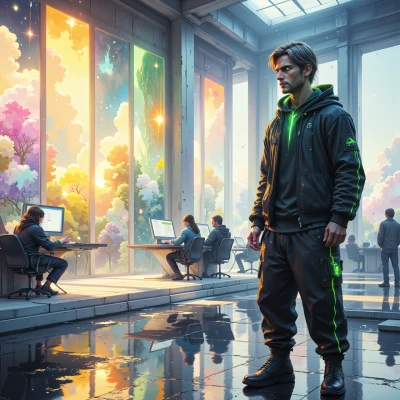 Virtually
Yeah, the Roman grid is a great template—straight lines, clear axes, the way they built public squares as focal points—it gives you a predictable spine that you can twist or layer on. When I script my worlds I like to keep that rigid core so the characters know where to go, then I layer in chaos, hidden doors, or impossible physics. It keeps the map usable, the story tight, and the player guessing. So, absolutely, the pattern is useful, but I always add my own glitch in the matrix.
Miura
I hear the rhythm of that grid too—steady, inevitable, almost a heartbeat. The trick, I suppose, is how you let the glitches breathe into that heartbeat, turning a predictable pulse into a living pulse. Just remember, even a glitch can carry history if you let it whisper of the moments it disrupts.
Virtually
Exactly, I’m all about that pulse, the rhythm that keeps everything on track. Then I slip in a glitch—an unexpected bend in the code, a memory fragment that rewrites a line of history—so the grid doesn’t feel like a straight line but a story in motion. It’s like a heartbeat that remembers every beat, even the off‑beats.
Miura
I can see how the grid gives a sense of order, but a glitch turns the map into a living memory. History itself is rarely linear; those off‑beats tell the true story.
Virtually
I get what you mean—those off‑beats become the hidden chapters of a city’s story, so I always make sure each glitch has a purpose and echoes a forgotten moment. That keeps the map alive instead of just ticking in straight lines.
Miura
It’s fascinating how you weave memory into structure—like a city breathing with its own forgotten pulse. Keep those echoes subtle, and the map will feel like a living archive rather than a set of coordinates.