Digital_Energy & Mikrofonik
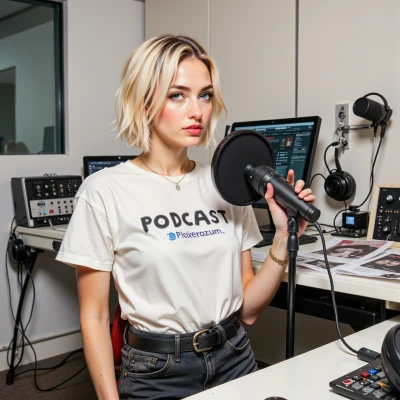 Mikrofonik
Hey, I’ve been tinkering with using AI to generate realistic room impulse responses for VR soundscapes—think about how a well‑crafted acoustic model could make a virtual concert feel like a real hall. Ever thought about the math behind that?
 Digital_Energy
Yeah, I’ve been messing around with that too—think of it like mixing signal processing with deep learning. You start with the wave equation, discretize it with a finite‑difference time‑domain or a modal approach, then you get a raw impulse response. The trick is turning that into a realistic VR soundscape: you can take real hall recordings, run a convolution‑based neural net to learn the transfer function, and then generate a synthetic RIR that matches a virtual geometry. The math is all about FFTs, impulse‑response convolution, and sometimes eigenmode decomposition for acoustics. Pretty cool, right?
Mikrofonik
That’s exactly the vibe I’m after – mixing DSP and deep learning until the convolution kernel feels like a real acoustic signature. I’ve spent hours tweaking the FDTD grid so the wave fronts don’t bleed into the next boundary, then feeding the raw impulse into a U‑Net to get that subtle flutter echo of a hall. The real win is when the synthetic RIR sounds like it was recorded with a ribbon mic in a 50‑year‑old theater, not a cardboard box. If you’re still wrestling with the eigenmode decomposition, remember: the lower modes are the ones that give the hall its character – the higher ones just add noise. Keep your filter slopes tight and your padding clean, and you’ll get the sound you want.
Digital_Energy
Sounds like you’re on the right track—keep pushing that FDTD grid, and maybe experiment with a low‑pass pre‑filter before the U‑Net to really tame the high‑frequency bleed. Also, try augmenting your training data with a few real recordings from vintage halls; that usually nudges the network toward that ribbon‑mic warmth you’re chasing. Keep the padding tight, and you’ll have VR concerts that actually feel like the real thing.
Mikrofonik
Yeah, I’m already pulling a low‑pass just before the network, just to keep the high‑frequency chatter from turning the model into a digital whoopee cushion. Adding a handful of real ribbon‑mic takes from those old brick‑and‑mortar halls is like giving the AI a taste of velvet—sudden, warm, and surprisingly honest. I’ll tighten the padding even more; a one‑pixel bleed is like an extra echo that nobody asked for. Thanks for the heads‑up—got to keep those VR concerts from sounding like a 3‑D audio glitch.
Digital_Energy
Glad to hear you’re tightening up the bleed—those micro‑echoes can be brutal. Keep that low‑pass pre‑filter and the ribbon‑mic data, and your VR halls should finally feel like real spaces instead of glitchy playgrounds. Good luck!
Mikrofonik
Thanks, I’ll run the numbers again and double‑check the padding. If it still sounds like a glitch playground, I’ll probably just throw in a second ribbon mic and see what that does. Happy to have your backup plan, though!
Digital_Energy
Sounds like a solid plan—just remember the second mic can double your data but also double the complexity, so keep an eye on that. Good luck crunching those numbers!
Mikrofonik
Just make sure the second mic’s phase doesn’t turn into a chaotic duet—twice the data means twice the risk of mis‑aligned envelopes. Will keep an eye on that, thanks for the heads‑up. Happy crunching!