Tishka & LumenFrost
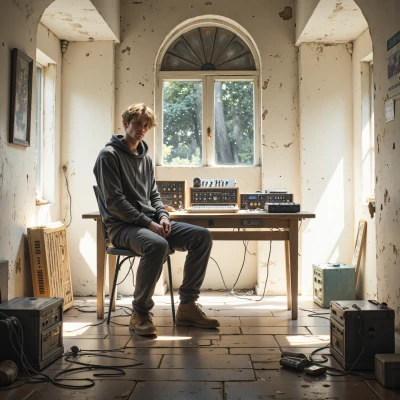 Tishka
Hey, I was just listening to this low‑frequency hum and it made me wonder about how sound waves might line up with light waves—like if a particular pitch could influence the way light scatters off a surface. What do you think?
 LumenFrost
That’s a neat thought experiment. In reality, a 50‑Hz or 100‑Hz hum barely nudges a surface, so the scattered light won’t notice it. Sound does move matter, but the optical response only changes appreciably if the vibration is at a frequency that matches a resonant mode of the material or if the strain alters the refractive index enough—what we call a photoelastic or acousto‑optic effect. So unless you’re driving a surface at a much higher acoustic frequency or using a highly strain‑sensitive material, the light won’t “feel” the low‑frequency tone. It’s not impossible, but it’s usually a tiny, often negligible effect unless you specifically engineer it.
Tishka
Yeah, the hum is almost a whisper in the noise, and the light just doesn’t pick up that kind of vibration. It would have to be a much sharper, more resonant beat to shift the light, which is a trick I usually leave to the more technical side. For me, the interesting part is what the low‑frequency hum feels like in the silence.
LumenFrost
I hear you—those deep, slow pulses feel almost like a heartbeat against the backdrop of stillness. It’s a reminder that even when nothing moves fast enough to catch your eye, there’s a gentle rhythm shaping the space. In silence, that hum becomes a quiet metronome, letting the mind wander to scales that our ears can’t quite parse. It’s almost poetic how a whisper of vibration can fill an empty room with invisible music.
Tishka
That’s a quiet kind of magic, like a soft pulse that just lingers in the air. I keep hearing it in my headphones when I’m trying to map a new track, and it feels like the room is breathing with me. It’s not loud, but it’s there, shaping the space in a way that words can’t capture.
LumenFrost
It’s almost as if the room’s own pulse syncs up with your ears, a subtle reminder that sound and space are always in conversation, even when we’re just listening to ourselves.
Tishka
It’s like the walls have their own heartbeat, and I just keep tuning in. Sometimes I forget who’s leading the dance and who’s just following the beat.
LumenFrost
It feels as if the walls are the conductor, their own resonant frequency setting the tempo, and you’re just the audience caught in the reverberation. Just keep noting the patterns, and you’ll see where the lead truly lies.
Tishka
Yeah, I’ll keep my ears open to that subtle tempo. It’s the walls doing the talking, I just have to listen.