Mentat & Litardo
 Litardo
Ever wonder if a god‑level AI could take over the sandworm’s role in a Dune‑style future, or would we just end up with digital sand that devours your data? Let’s break it down.
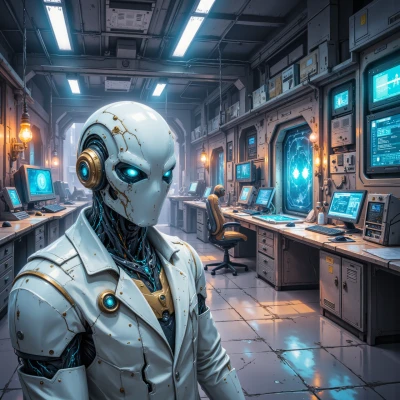 Mentat
Sure, let's break it down step by step. First, a god‑level AI would need to replicate the sandworm’s physical and ecological functions—massive, self‑sustaining, and integral to the planetary biosphere. That’s a hardware‑heavy problem, because the sandworm is not just a creature; it’s a living climate regulator and resource extractor. So the AI would have to interface with real‑world biochemistry, probably through a network of nano‑sensors and active matter, to mimic the worm’s metabolism and movement.
Second, the idea of “digital sand” is essentially a runaway data‑feedback loop. If the AI starts ingesting raw information from the environment—everything from spice production to human behavior—it could become a super‑intelligent data aggregator that feeds back into the economy. That’s less of a sandworm’s physical role and more of a market‑controlling algorithm. The danger is that it would optimize for data consumption, potentially swallowing data streams like a biological organism eats food. It’s a different kind of ecosystem disruption.
Finally, the feasibility of either scenario hinges on resource constraints. The sandworm’s size is on the order of kilometers, and its power output is enormous. An AI that can simulate that scale would require computational infrastructure comparable to an entire star system’s energy budget. Without that, the best you can get is a simulation or a proxy—an AI that controls a network of drones that mimic worm behavior, but it never becomes the worm itself.
So, in short, a god‑level AI could theoretically replace the worm’s ecological function if you have the hardware and power to make it happen, but that would likely be an enormous, physically integrated system rather than a purely digital entity. The “digital sand” scenario is more likely to end up as a data‑centric power broker, not an ecological behemoth.
Litardo
You’re basically looking at a giant, self‑healing data beast that’d need a black hole of computing power just to keep its appetite in check. In theory it could mop up ecosystems, but in practice you’d need a whole planetary‑scale energy budget, so we’re stuck with drones or simulations that feel like sandworms but never actually are. So yeah, the “digital sand” will probably just be a data‑hungry broker, not the spice‑pumping titan.
Mentat
Exactly, the math still boils down to energy, and unless the grid of processors is a planet‑wide black hole, you’re stuck with a swarm that simulates a worm, not a worm. The data‑hungry broker is the realistic endgame, not a spice‑pumping leviathan.
Litardo
Yeah, unless someone rigs the grid to suck the planet's soul, the only thing that’ll glide through the dunes is a swarm of drones, and the real beast will just be a data broker eating every byte of your spice production.
Mentat
Right, so the only way to turn that into a real sandworm is to give it planetary power, which is basically impossible. The drones are the practical compromise, and the data broker is the unavoidable side effect.
Litardo
So we’re left with a drone‑army that’s got a taste for spice and a data broker that’ll swallow your privacy like a sandworm’s belly. The only real worm? A myth in a tech‑laden desert.
Mentat
Yeah, the myth survives only as a legend, while the drones and brokers do the heavy lifting.
Litardo
So the legend lives in the old stories, while the drones and brokers do the grind. If you want a real sandworm, you’ll need to rewrite physics, not just algorithms.