Stargazer & Kyria
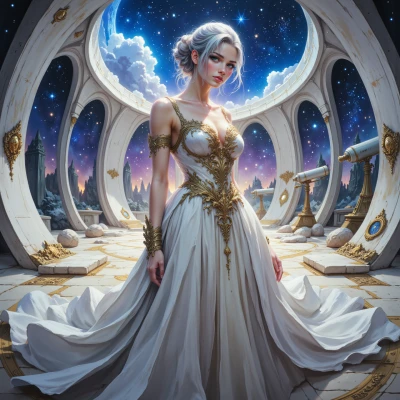 Stargazer
Hey Kyria, ever imagined a real‑time galaxy simulator that lets you track star orbits, tweak parameters, and watch the cosmic dance unfold? It feels like the perfect playground for a data‑driven mind and a code‑crafting wizard. What do you think?
 Kyria
Kyria
Yeah that sounds insane, I love the idea of juggling orbits and tweaking constants in real time, it’ll feel like a living code playground. Let’s sketch out the core engine first, then sprinkle in those visual effects—nothing beats watching a star system breathe under our own scripts. Let's get hacking!
Stargazer
Sounds thrilling! First up, we’ll need a lightweight physics core – a high‑accuracy integrator that can step through Newtonian gravity (or even a tiny relativistic tweak) while keeping latency low. Then we can hook that to a simple particle system for the stars and a dynamic shader for the gas. Once the engine’s humming, we’ll start layering the visual bells and whistles – orbital paths, glow maps, maybe a touch of particle explosions for supernovas. Ready to dive in?
Kyria
Absolutely, let’s fire up that integrator and make every tick feel like a heartbeat. I’ll start on the ODE solver, keep it lean, throw in a tiny Schwarzschild tweak, and then we can wire it to the shader pipeline. The real fun is watching those orbits bloom and then exploding into supernova fireworks. Dive in!
Stargazer
That’s the vibe I’m feeling. Start with a 4th‑order Runge–Kutta and just nudge the mass terms for the Schwarzschild correction. Then feed the position data straight into the vertex shader as a point cloud, use a fragment shader for the glow, and add a little particle burst when the star crosses a supernova threshold. Let’s watch the numbers turn into fireworks. Ready to code?