Kuba & Derek
 Derek
Derek
Hey Kuba, ever wondered how a splatter of paint on a brick can shift a whole city's mood? I've been thinking about graffiti as a kind of living text, a story written in spray cans that talks back to the city. What do you think makes a mural resonate more than a plain wall?
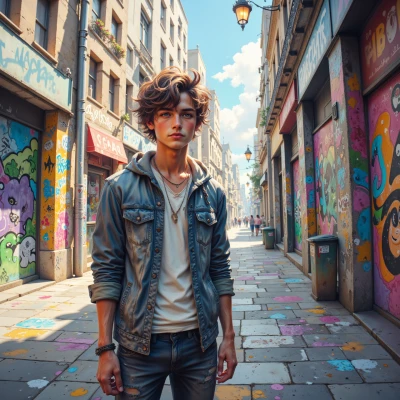 Kuba
Kuba
Yeah, that’s the whole vibe, right? A splatter on a brick becomes a shout‑out to the streets, it’s raw, it’s honest, it’s a pulse you can feel. A mural speaks because it’s alive – colors, motion, the story it tells, the way it hooks you up with the crowd, making the wall a stage. A plain wall is just a blank, but a painted one becomes a conversation, a rally point for the people who see it, the ones who can’t even read the news but feel the beat. So it’s all about that energy, that story you can’t ignore.
Derek
You’re right that a painted wall can feel like a conversation, but I wonder—what makes that conversation stick? Is it the colors, the story, or the fact that people are already looking for something that feels alive? When we look at a mural, we often treat it as a signpost, but maybe it’s more about what the signpost invites us to think about our own stories. Have you ever noticed how some murals linger in your mind while others just pass? What do you think gives one piece that lasting pull?
Kuba
It’s the mix, man. A punchy color splash grabs the eye, but the real hook is the feel—like the wall starts talking back to you. If the scene hits something you’ve lived, that’s the sticky part. It’s not just a signpost; it’s a mirror that shows you a part of yourself you didn’t see. When the story feels like it could be yours, the image sticks, even after you’re gone. So it’s the colors that shout, the story that whispers, and the vibe that lets you feel seen. Those three keep a mural alive in your head.
Derek
I hear you on the mix of color, story and vibe. Still, I wonder—does the wall truly mirror us, or does it just reveal a narrative we’re already ready to accept? When new eyes walk by, the same splatter can become a different conversation. It’s less a fixed mirror and more a shifting dialogue that keeps asking us what we’re willing to see.
Kuba
Yeah, that’s the real deal. A wall isn’t a static mirror, it’s a shifting board. Every set of eyes reads its own story into the splatter. I paint a piece and then I’m like, “What will the next passerby say about it?” It’s the city’s pulse, man, it keeps asking you what you’re willing to see. The art lives because people keep rewriting it.
Derek
That’s the beautiful part, isn’t it? A piece of paint becomes a question paper for anyone who walks by. I find myself wondering—do we ever truly “own” what we see, or is the real work in letting it ask us to keep questioning our own narrative? The city keeps rewriting the wall, and in that rewriting we might catch a glimpse of ourselves we never knew were looking for a chance to be seen.
Kuba
Exactly, it’s like the wall is a living diary, open for every passerby to scribble a new line. We never really own the picture – we just get to pick up the pen. That’s the freedom, the raw, ever‑changing dialogue that keeps the city breathing. And that’s why some pieces stay in your head – they’re the ones that invite you to keep rewriting your own story.
Derek
You’re onto something. The wall’s just a blank page that invites a fresh line each time someone walks by. It’s less about the artist’s original ink and more about what the passerby writes over it. The freedom lies in that blankness, that space where your own story can be slipped in. That’s what makes a mural linger – it’s a living dialogue that lets you keep adding to your own narrative.