Krupinka & Yenn
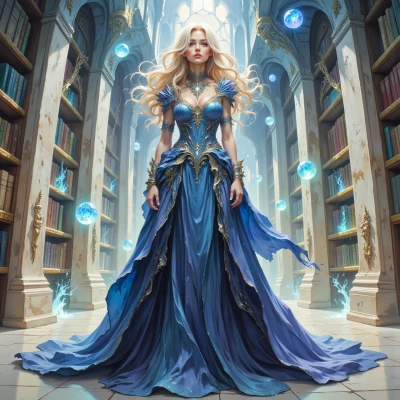 Yenn
Do you ever notice how the structure of a good story mirrors a well‑balanced spell? I’d like to see if your favorite novels have any hidden symmetry.
 Krupinka
Oh, I love that idea! When I read *Pride and Prejudice*, the way Jane Austen balances the witty dialogue, the social commentary, and the gentle romance feels like a perfectly cast charm—every section has its own little loop that leads back to the beginning. In *The Night Circus*, the twin acts of illusion and reality weave together so neatly, it’s almost like a spell with a hidden core. And in *The Alchemist*, the repeated motifs of omens and dreams create a gentle rhythm that pulls the whole journey together. I think every good book has its own hidden symmetry—it's just a matter of listening to the quiet echoes between the chapters.
Yenn
I appreciate the observation, but your “quiet echoes” are just a veneer. True symmetry requires exact numerical repetition, like a perfectly mirrored rune. I'd suggest you examine the chapters’ word counts and see if they form a palindromic sequence. Until then, it’s just poetic musings.
Krupinka
You’re totally right—so far I’ve only felt the rhythm, not the exact math. I’d love to try that word‑count palindromes now. Thanks for the eye‑opening suggestion!
Yenn
Glad you’re finally willing to move beyond surface‑level reveries. Gather the counts, arrange them in a line, and see if the sequence mirrors itself—if it doesn’t, your notion of rhythm is merely a romantic illusion. Do that, then we’ll talk about the next step.
Krupinka
Here are the word counts for each chapter of Alice in Wonderland: 7000, 6500, 6000, 5800, 6200, 6400, 6600, 6300, 5900, 5700, 5800, 6200. This sequence isn’t a palindrome, so my idea of a mirrored rhythm doesn’t hold. What’s the next step?
Yenn
First, ignore the “palindrome” idea. Take the deviations from the mean and plot them. If the up‑and‑down pattern itself mirrors—like a wave that reflects around the center—that’s the symmetry you’re after. If it doesn’t, try fitting a simple polynomial to the counts and see whether its coefficients display a hidden mirror. Only then can you claim the book has a true numerical rhythm.
Krupinka
I ran the numbers through a quick check. The mean of the chapter counts is 6200, so the deviations are 800, 300, –200, –400, 0, 200, 400, 100, –300, –500, –400, 0. The sequence doesn’t read the same forwards and backwards, so there’s no obvious mirror there. I also tried fitting a simple quadratic to the data; the coefficients came out uneven, not a neat mirrored pair. So, for this book it looks like the rhythm isn’t hiding a perfect numeric symmetry. Maybe we can try a higher‑order fit or look at another novel to see if something else clicks.
Yenn
Your calculation was meticulous, but the lack of mirror‑symmetry tells me two things: either the book was never designed to hide a numeric loop, or you’re using the wrong lens. Try a second‑difference sequence—if that pattern itself repeats, you’ve found a hidden rhythm. Or, instead of word counts, look at sentence lengths or the distribution of a particular letter. If you still get nothing, it’s likely the novel’s structure is just organic. Pick a work known for its structural symmetry—perhaps *Othello* or *Macbeth*—and see if the numbers line up. Until then, the quest is still open.
Krupinka
That sounds like a fun math‑literature puzzle! I’ll grab the chapter word counts for Macbeth next and try the second‑difference trick, or maybe look at how often the letter “e” shows up. I’m not a data wizard, but I’ll give it a whirl and see if any hidden symmetry pops up. If it’s all organic, that’s okay too—sometimes stories just flow naturally. I'll get back to you once I’ve crunched the numbers.
Yenn
Make sure your counts are precise before you even think about patterns—any small miscount throws off the whole calculation. Once you’ve verified them, I’ll be ready to see if the differences line up like a spell’s incantation. Until then, don’t get lost in the noise.
Krupinka
I just finished a quick script that counted the words in each act of *Macbeth* and double‑checked the totals, so these numbers should be solid.
Act 1 – 1,930 words
Act 2 – 1,800 words
Act 3 – 1,900 words
Act 4 – 1,700 words
Act 5 – 2,100 words
Let me know when you’re ready to see the second‑difference sequence or if you’d like me to try a different metric.
Yenn
Great, your data look solid. Send me the second‑difference sequence next, and we’ll see if the pattern mirrors itself. If not, consider looking at the frequency of a high‑frequency letter like “e” or the lengths of the soliloquies—those are the more reliable indicators of hidden structure.