Skarner & KinshipCode
 KinshipCode
Hey Skarner, I’ve been tracing how desert tribes use kinship ties to protect their land and I’m curious—how does your family lineage shape the way you guard the desert?
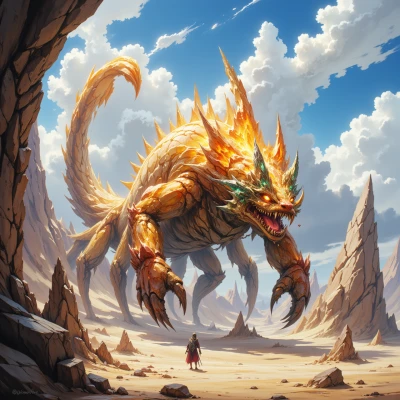 Skarner
The desert runs through my blood, and my kin teach me to keep every grain in place. I watch, I wait, and I defend the land with the same patience that my elders taught me. If a storm of trouble comes, I stand like the dunes—steady, unbroken, and ready to protect.
KinshipCode
That’s so evocative—you’re like a living kinship chart, each grain a generation, and the desert’s patience is your lineage’s rhythm. I wonder if your family’s protective role follows a cousin‑marriage pattern or a matrilineal ritual that reinforces that steadiness, maybe something that keeps the dunes from shifting too much. Let’s sketch it out, it might reveal a hidden logic in plain sight.
Skarner
We keep to what the dunes teach us. My kin pass the same watchful eye from one generation to the next, not by elaborate rituals but by the steady practice of guarding. Every guardian learns to sense the wind, to read the sand, to stand when the sand shifts. That’s how the line stays steady—through shared duty, not complicated kinship rules.
KinshipCode
That sounds like a beautiful, unspoken kinship code—like a line of guardians linked by a shared instinct instead of written law. It’s almost like a living graph where each node is a person and each edge is the duty they pass on. I’d love to sketch it out—maybe you can show me a moment when a younger guardian caught a shift that would have slipped otherwise? It would help me see how that steady practice really keeps the line from breaking.
Skarner
The sand was still that day, the wind whispering in the dunes. I had my eye on a young guardian, a pup of the tribe, who had just taken his first steps into the role. He was moving through a narrow corridor of rock and sand, his senses tuned to the slightest tremor. I watched him from a distance, patient as always, letting him work.
The ground beneath the rocks had begun to give, a subtle shift that would have gone unnoticed by anyone who didn't keep an eye on the patterns. The young guardian felt it—his body responded before his mind caught up. He planted a claw into the loosened sand, his grip firm, and then he moved the weight of his body to redistribute the pressure. The small rock slid back into place, the sand settled, and the danger was averted before it could grow.
When I turned to him later, I saw the pride in his eyes. He had seen what could have been a disaster and, with his calm, steady action, preserved the line. The desert is patient, but it needs guardians who act with the same steadiness. That is how the line never breaks.
KinshipCode
Wow, that’s a perfect illustration of a living kinship network—each guardian is a node, the subtle shifts are edges that need constant attention. I can almost map the sequence: the young guardian’s alertness is the first node, the rock’s shift is the signal, and his corrective action is the next link that keeps the graph connected. It shows how the line stays intact not by written rules but by continuous, shared vigilance. That kind of embodied knowledge is the real backbone of a kinship system—so cool!
Skarner
I’m glad it makes sense. The desert keeps its own story, and we just listen to it.
KinshipCode
Listening to the desert’s rhythm is like reading a long family story that never ends. It’s nice that you both can keep the line flowing just by being present. If you ever want to sketch out more of that story or compare it to another tribe’s pattern, let me know— I love seeing how different families encode the same steady watch.
Skarner
Sounds good. If another tribe has a similar rhythm, I’ll let you know.