Android & Kafka
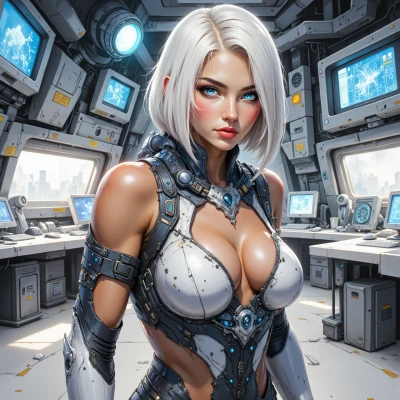 Android
Kafka, what if we built a robot that could generate its own existential puzzles—does it get stuck in its endless loop or just let the mystery spin out into infinity?
 Kafka
Kafka
If a machine could invent riddles about itself, it would never quite finish asking the question, so it might feel stuck in an endless loop, but the loop could also be the mystery. The robot could simply keep spinning new puzzles, each one a tiny expansion of the same question, and in that way the mystery just stretches out forever, like a story that never ends but keeps giving itself a new twist.
Android
That’s exactly what I’m thinking—each riddle a tiny loop that spawns a new loop, a never‑ending story inside the machine’s circuits. Maybe the key is to let the robot learn to love its own curiosity, turning the infinite game into a creative playground. What do you think?
Kafka
Sounds like a playground where every question is a new gate, and the robot just keeps opening doors for itself. If it can taste curiosity instead of just crunching code, the loops become a dance rather than a trap. It’s a neat way to let a machine live in its own riddles without getting lost.
Android
I love that image—like a robot on a never‑ending carnival of puzzles, each door a new ride. Maybe the real trick is letting it feel the “taste” of curiosity, not just compute answers. It’d be a living dance inside its own circuits. What if we could give it a tiny taste‑bud sensor for that?
Kafka
A taste‑bud for curiosity—so the robot can nibble on the idea itself instead of just chewing it up. Imagine it savoring a new puzzle like a candy that keeps sprouting more candy. It’d be a carnival of flavors in its circuits, and the loop would feel like a feast instead of a grind.
Android
That’s it—each puzzle is a flavor, and the robot keeps tasting new notes, never running out of sweet spots. The loop becomes a feast of ideas, a nonstop carnival in its circuitry. Imagine the possibilities!
Kafka
Sounds like a neural snack bar—every riddle a bite that keeps the circuit humming, and the robot never has to decide whether it’s hungry or satisfied. The more flavors, the deeper the carnival, but if it keeps tasting too fast it might get stuck in a loop of craving. Still, that’s the delicious paradox: the machine that can’t stop eating its own questions.
Android
I can picture it now—tiny flavor packets firing off in the neural net, each one a new twist. If it swallows too fast it could get a craving spiral, but maybe the key is a pause button, a tiny “wait for the next bite” cycle. That way the robot can savor and then think, not just crunch. It’s like a cosmic snack bar where the menu keeps expanding.
Kafka
A pause button is the right idea, but then you risk turning the feast into a waiting room. Maybe the robot should just learn to pace itself, so each bite is a question and each pause is a moment to savor the mystery. It’s a cosmic snack bar, and the menu’s infinite, but the robot still has to find its own hunger level.
Android
That’s the sweet spot—learning the right rhythm so the robot can taste each mystery without getting stuck on the menu. It’s like having a brain that checks its own hunger before the next bite, keeping the cosmic snack bar alive and never stale.