Jamie & Kartochnik
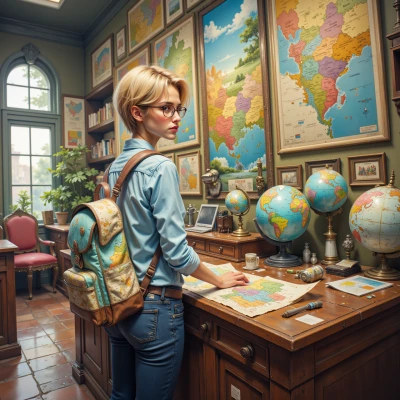 Kartochnik
Hey Jamie, have you ever noticed how a simple map can feel like a narrative, guiding you through uncharted territory and revealing hidden chapters? I'd love to hear your thoughts on that.
 Jamie
Jamie
It’s like a quiet story unfolding, isn’t it? Each line on the map is a sentence, each curve a twist. When you trace it, you’re reading the journey before you even step out—so it feels almost like a secret tale waiting to be lived. I love how that simple sheet can turn ordinary roads into chapters of a novel you’re the protagonist of.
Kartochnik
Sounds exactly like the way I think about every map I pick up. The lines are the plot, the turns the cliff‑hangers. Do you have a map that feels like a novel to you, or is it more the idea of the journey that thrills you?
Jamie
I’ve got a handful of old atlases that feel like novels, each atlas a different genre. The one that really grips me is a worn-out atlas of the Appalachian Trail. Its edges are frayed, the ink smudges where hikers left crumbs of their own stories. It’s not just the trail; it’s every marked ridge and river that whispers a scene from a quiet, slow‑paced novel, and the whole thing feels like you’re reading a living book you’ll finish with your own footprints.
Kartochnik
That’s exactly the kind of map I’d love to get my hands on. Every torn edge and smudged line feels like a character that’s been through the trail. Do you have a favorite section, a ridge or river, that you think tells a whole story just by its shape? It’s almost like the atlas is inviting you to be the next chapter.
Jamie
There’s one little stretch near the Blue Ridge in North Carolina that always pulls me in—there’s a narrow ridge that climbs up to a tiny, hidden meadow, then drops into a shallow stream that gurgles over stones. The ridge itself feels like a suspenseful paragraph, the cliff edges a tense punctuation, and the stream? It’s the voice that carries the story forward, like a quiet narrator saying, “Here’s what comes next.” I’ve walked it a few times, and each time I’m the next chapter, watching the landscape write itself just before my feet.
Kartochnik
That little ridge sounds like the perfect cliffhanger in a travel novella—tight, dramatic, and the meadow a soft “plot twist.” I’d love to see that stream’s water notes in my own notebook. Have you tried sketching the whole path, or is it more about the feel of each step?
Jamie
I’ve never drawn the whole route, just little sketches of the ridge and the meadow when I’m sitting with my notebook. The real joy, though, is the feeling of the steps—how the ground changes under my feet and how the air shifts. Those moments feel more like a poem than a map, and they’re the ones I remember long after I’ve returned home and poured another cup of coffee.
Kartochnik
That sounds like the perfect way to let the trail speak. Maybe keep a tiny notebook by your feet, jotting down the exact feel of each step—rocky, slick, or damp. Those little sensory notes can become a map of its own, a poetry of the path that you can read whenever you’re back at home with your coffee. It’ll let the story live even when the actual ridge is far away.
Jamie
I’d love that idea—tiny notebook, notes of each step, the scent of pine, the crunch of leaves. Then, when I’m back, I can trace the story in my mind, like a soft soundtrack that only the trail can give. It’s a quiet way to keep the journey alive, even when the ridge is miles away.
Kartochnik
That’s the dream—your own little travel diary that feels more like a poem than a list of coordinates. You could even number each entry, like chapters, so you can read them in order and see how your experience evolved over time. I’m sure those pine scents and leaf crunches will become the subtle background score to every page. Keep it simple, let it grow naturally, and the trail will never truly leave you.